If you’ve ever wondered why some affiliate websites consistently rank on Google while others struggle to get noticed, the answer often comes down to Topical Authority for Affiliate Marketing. Simply publishing random product reviews or targeting popular keywords isn’t enough anymore. Search engines now favour websites that demonstrate deep knowledge and consistently provide valuable content around a specific topic.
Topical authority is the process of becoming a trusted resource within your niche by covering it comprehensively. Instead of writing isolated articles, you create a network of helpful, interconnected content that answers your audience’s questions at every stage of their journey. This approach not only improves your search rankings but also builds credibility, increases organic traffic, and leads to more affiliate conversions over time.
In this guide, you’ll discover what topical authority is, why it’s the secret to long-term affiliate marketing success, and the practical steps you can take to build it—even if you’re just starting your affiliate marketing journey. By the end, you’ll have a clear roadmap for creating content that both search engines and readers trust.
Ready to build an affiliate website Google trusts? WATCH THIS VIDEO >>>
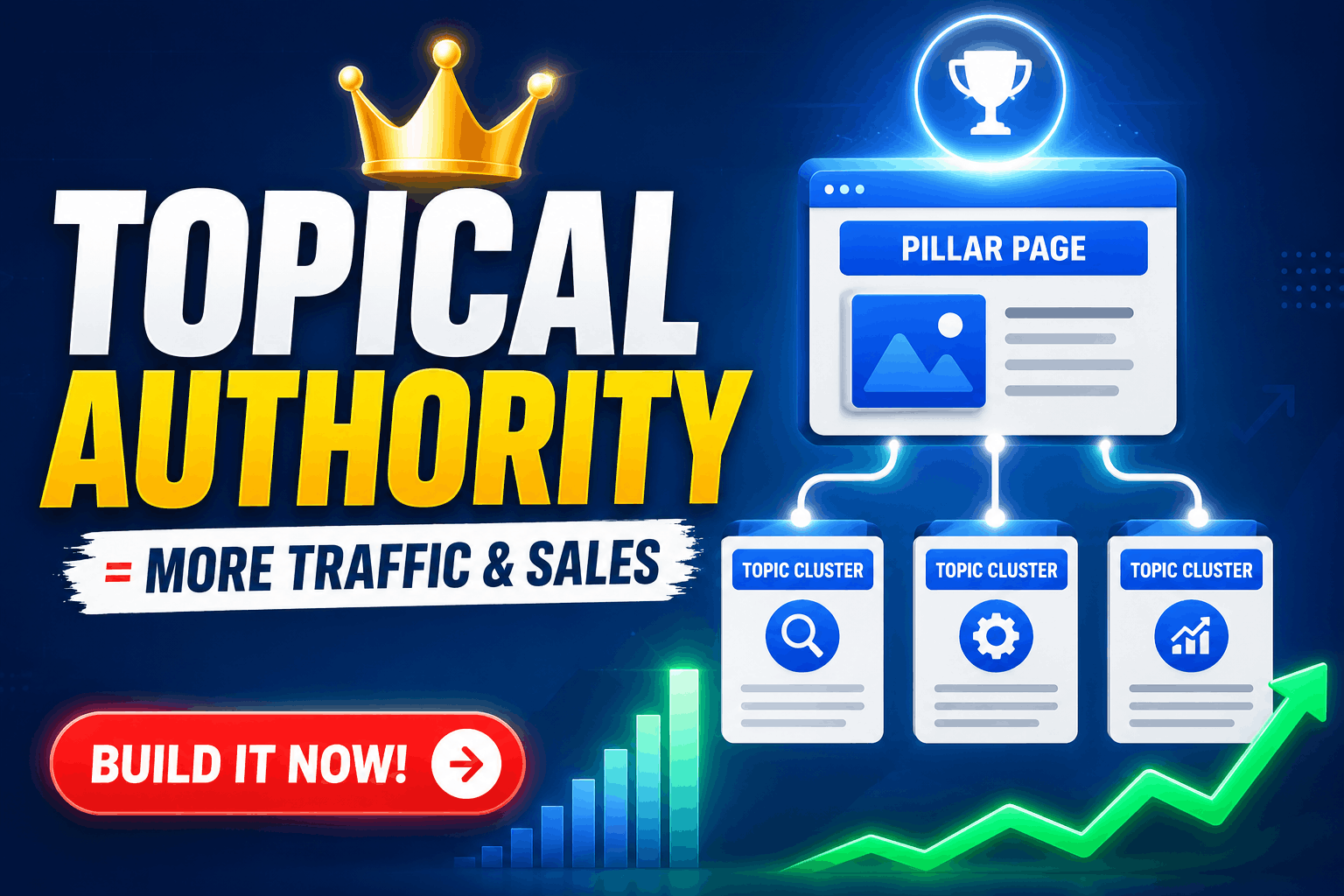
What Is Topical Authority for Affiliate Marketing?
Topical authority is the process of becoming a trusted and reliable source of information on a specific subject. In affiliate marketing, it means creating comprehensive, high-quality content around a particular niche rather than publishing random articles on unrelated topics. When your website consistently covers every important aspect of a topic, search engines are more likely to recognize it as an authoritative resource and rank it higher in search results.
For example, instead of writing only a few articles about affiliate marketing, a website with strong topical authority publishes content on beginner guides, affiliate programs, SEO, content marketing, email marketing, AI tools, traffic generation, conversion optimization, and other closely related subjects. These articles are strategically connected through internal links, creating a content ecosystem that demonstrates expertise and helps users find answers to all their questions in one place.
This approach not only improves your visibility in search engines but also builds trust with your audience. Visitors are more likely to return, explore additional content, and follow your recommendations when they see your website as a valuable source of information rather than a collection of isolated articles.
Why Topical Authority Matters
Search engines have evolved significantly over the years. Instead of ranking pages based solely on individual keywords, they now evaluate how well a website covers an entire subject. Google’s algorithms aim to deliver the most helpful and trustworthy content, rewarding websites that demonstrate expertise, experience, authoritativeness, and trustworthiness (E-E-A-T).
Building topical authority offers several important benefits for affiliate marketers:
- Improves rankings for a broader range of related keywords.
- Increases consistent organic traffic over time.
- Builds credibility and trust with your audience.
- Helps new content get indexed and ranked more quickly.
- Strengthens your website’s relevance within a specific niche.
- Increases the likelihood of earning more affiliate commissions.
Topical Authority vs. Domain Authority
Although these terms are often used interchangeably, they represent different concepts.
| Topical Authority | Domain Authority |
| Measures your expertise in a specific topic or niche. | Estimates the overall strength of an entire website based largely on backlinks. |
| Built through comprehensive, high-quality content and semantic relevance. | Influenced by backlink quality, quantity, and overall website reputation. |
| Helps individual topic clusters rank better. | Reflects the site’s general ability to compete in search results. |
| Controlled primarily through your content strategy. | Influenced by both content and external link-building efforts. |
For affiliate marketers, topical authority is often more achievable and sustainable than relying solely on backlinks. By consistently publishing valuable, interconnected content within your niche, you can build trust with both search engines and readers—even if your website is relatively new.
A Simple Example
Imagine two affiliate websites that both promote email marketing software.
- Website A has only three articles:
- Best Email Marketing Tools
- Mailchimp Review
- ConvertKit Review
- Website B has more than 50 well-organized articles covering:
- Beginner guides to email marketing
- Email list-building strategies
- Lead magnets
- Email automation
- Landing pages
- A/B testing
- Email deliverability
- Product comparisons
- In-depth software reviews
- Tutorials, FAQs, and case studies
Which website would Google consider the more authoritative source on email marketing? The answer is Website B, because it demonstrates comprehensive expertise and provides users with a complete learning resource rather than isolated pieces of content.
This is the essence of topical authority for affiliate marketing. The more thoroughly and consistently you cover your niche with valuable, interconnected content, the more likely search engines are to view your website as a trusted authority—leading to higher rankings, increased organic traffic, and greater affiliate marketing success.
Why Topical Authority Is the Secret to Affiliate Marketing Success
Building a successful affiliate marketing business is no longer just about targeting high-volume keywords or publishing dozens of product reviews. Search engines have become much smarter, prioritizing websites that consistently demonstrate expertise within a specific niche. This is where topical authority becomes a game-changer.
When your website covers a subject in depth, answers related questions, and connects content through a logical structure, search engines gain confidence that your site is a reliable resource. As a result, you’re more likely to achieve higher rankings, attract qualified visitors, and earn more affiliate commissions over time.
Simply put, topical authority transforms your website from a collection of individual articles into a trusted knowledge hub. Here are the key reasons why it’s the foundation of long-term affiliate marketing success.
1. Improves Search Engine Rankings
One of the biggest advantages of building topical authority is better visibility in search results. Instead of ranking for only a handful of keywords, your website becomes eligible to rank for hundreds—or even thousands—of related search queries.
For example, if your niche is affiliate marketing, publishing comprehensive content about beginner guides, traffic generation, email marketing, AI tools, SEO, affiliate programs, and conversion optimization signals to search engines that you have extensive knowledge of the topic.
As your topical coverage expands, search engines are more likely to rank both your existing and newly published articles because they recognize your website as an authoritative source.
2. Builds Trust and Credibility
People are more likely to trust a website that consistently provides accurate, helpful, and well-organized information. When visitors find answers to multiple questions on your site without needing to search elsewhere, they begin to view you as a reliable expert rather than someone simply promoting affiliate products.
This trust has a direct impact on your affiliate marketing success. Readers who value your recommendations are far more likely to click your affiliate links, subscribe to your email list, and return for future content.
Remember, people don’t buy because a product has an affiliate link—they buy because they trust the person recommending it.
3. Drives Consistent Organic Traffic
Many affiliate marketers experience fluctuating traffic because they rely on a few high-ranking articles. If those pages lose rankings, their traffic drops dramatically.
Topical authority reduces this risk by creating multiple entry points to your website. Instead of depending on one or two pages, dozens of interconnected articles can rank for different search terms, bringing a steady flow of organic visitors.
This diversified traffic strategy makes your website more resilient to algorithm updates and provides a stronger foundation for long-term growth.
4. Increases Affiliate Conversions
High traffic alone doesn’t guarantee affiliate income. The quality of your visitors matters just as much.
When your content addresses every stage of the buyer’s journey—from learning about a topic to comparing products and making purchasing decisions—you attract readers with genuine intent. By the time they reach your product reviews or recommendations, they’ve already gained confidence in your expertise.
This naturally leads to higher click-through rates, better engagement, and increased affiliate conversions without relying on aggressive sales tactics.
5. Strengthens Your Website’s E-E-A-T Signals
Google evaluates websites using the principles of Experience, Expertise, Authoritativeness, and Trustworthiness (E-E-A-T). While no single ranking factor determines success, demonstrating these qualities helps search engines assess the credibility of your content.
Topical authority supports E-E-A-T by encouraging you to:
- Publish comprehensive, experience-driven content.
- Cover related subjects in depth.
- Keep articles accurate and up to date.
- Build meaningful connections between pages.
- Consistently provide value to your audience.
Over time, these signals help establish your website as a trustworthy resource within your niche.
6. Helps New Content Rank Faster
As your website gains topical authority, newly published articles often benefit from the trust you’ve already established. Because search engines recognize your expertise in a specific subject, they can more easily understand and evaluate new content related to that niche.
For example, if your website already contains dozens of high-quality articles about affiliate marketing, publishing a new guide on affiliate marketing tools is more likely to gain visibility than if it were published on a site with little or no related content.
This means your content ecosystem becomes stronger with every valuable article you add.
7. Creates a Better User Experience
Topical authority isn’t just about pleasing search engines—it’s about helping people.
Visitors appreciate websites where they can easily explore related topics through logical navigation and internal links. Instead of searching multiple websites for answers, they can continue learning within your content ecosystem.
This improves important engagement metrics such as:
- Time spent on your website.
- Pages viewed per session.
- Lower bounce rates.
- Higher return visitor rates.
A positive user experience benefits both your audience and your SEO performance.
8. Delivers Sustainable Long-Term Growth
Many SEO tactics produce only temporary results, but topical authority is a long-term investment. Every high-quality article, internal link, and content update strengthens your website’s overall expertise.
Rather than chasing every trending keyword, you’re building a valuable digital asset that continues to attract visitors, generate affiliate commissions, and grow over time.
This sustainable approach is especially important in today’s AI-driven search landscape, where search engines increasingly reward websites that consistently demonstrate genuine expertise and provide comprehensive coverage of their chosen topics.
Key Takeaway
Topical authority is the foundation of modern affiliate marketing success. By focusing on one niche, publishing comprehensive and interconnected content, and consistently providing value, you create a website that search engines trust and users rely on. The result is stronger rankings, steady organic traffic, increased credibility, and higher affiliate earnings that can continue growing for years.
Choose One Profitable Affiliate Niche
One of the biggest mistakes beginners make is trying to build an affiliate website that covers everything. They write about affiliate marketing today, cryptocurrency tomorrow, fitness next week, and personal finance the week after. While this approach may seem like a way to attract more visitors, it actually makes it harder for search engines to understand what your website specializes in.
If your goal is to build topical authority, you need to focus on one profitable affiliate niche and create content that thoroughly covers that topic. By narrowing your focus, you position your website as a trusted resource instead of just another blog publishing random articles.
Think of your website as a library. A library dedicated to digital marketing is far more useful to someone interested in online business than a library containing unrelated books on gardening, cooking, fitness, and technology. The same principle applies to your affiliate website.
Why Choosing One Niche Matters
Search engines aim to provide users with the most relevant and trustworthy results. When your website consistently publishes content around a single niche, Google can more easily understand what your site is about and which searches it should rank for.
A focused niche also helps you build a loyal audience. Visitors know what to expect from your website and are more likely to return because your content consistently addresses their interests and challenges.
Some key benefits of choosing one niche include:
- Build topical authority faster.
- Improve keyword rankings across related topics.
- Create a stronger brand identity.
- Attract a more targeted audience.
- Increase reader trust and engagement.
- Generate higher-quality affiliate conversions.
Instead of trying to appeal to everyone, you’ll become the go-to resource for a specific group of people.
How to Choose a Profitable Affiliate Niche
Not every niche is suitable for long-term affiliate marketing success. The best niches combine strong audience demand, quality affiliate programs, and opportunities to create a wide range of helpful content.
When evaluating a niche, ask yourself the following questions:
- Is there consistent search demand throughout the year?
- Are people actively searching for solutions and products?
- Are there reputable affiliate programs with competitive commissions?
- Can I create at least 50–100 high-quality articles on this topic?
- Will this niche still be relevant several years from now?
- Does the niche solve real problems or help people achieve meaningful goals?
If you can confidently answer “yes” to these questions, you’ve likely found a niche with long-term potential.
Examples of Strong Affiliate Niches
Some niches naturally lend themselves to building topical authority because they offer endless educational topics, product reviews, comparisons, tutorials, and problem-solving content.
Popular examples include:
- Affiliate Marketing
- Search Engine Optimization (SEO)
- Artificial Intelligence (AI) Tools
- Email Marketing
- Web Hosting
- WordPress
- Blogging
- Content Marketing
- Online Business
- Freelancing
- Productivity Software
- Graphic Design Tools
- Video Editing Software
- Cybersecurity and VPNs
- Personal Finance
Each of these niches contains hundreds of related subtopics that allow you to build a comprehensive content library over time.
Think in Topics, Not Just Keywords
Many beginners choose keywords before they choose a niche. A better approach is to think in terms of topics.
For example, if your niche is Affiliate Marketing, your content could naturally expand into related areas such as:
- Affiliate Marketing for Beginners
- Affiliate Programs
- Affiliate Networks
- SEO for Affiliate Marketing
- Content Marketing
- Email Marketing
- AI Tools for Affiliates
- Keyword Research
- Website Traffic
- Conversion Optimization
- Landing Pages
- Passive Income Strategies
- Affiliate Marketing Mistakes
- Case Studies and Success Stories
Together, these interconnected topics create a strong content ecosystem that signals expertise to search engines.
Avoid the “Shiny Object Syndrome”
Many affiliate marketers constantly jump from one trending topic to another because they believe it will generate faster results. While covering trending subjects can occasionally be beneficial, constantly switching niches prevents you from building authority.
For example, publishing one article about AI, another about stock investing, another about fitness supplements, and another about travel doesn’t establish your website as an expert in any one area.
Instead, stay committed to your chosen niche and expand your coverage gradually. Every new article should strengthen your existing content rather than pulling your website in a completely different direction.
Your Niche Can Grow Over Time
Choosing one niche doesn’t mean you’re locked into a single topic forever. As your website gains authority, you can naturally expand into closely related subjects.
For example:
- Affiliate Marketing → SEO → Blogging → Email Marketing → AI Tools → Content Marketing
Because these topics are closely connected, expanding into them reinforces your website’s expertise instead of diluting it.
The key is to grow horizontally within your niche, not randomly across unrelated industries.
Key Takeaway
Choosing one profitable affiliate niche is the foundation of building topical authority. A focused niche allows you to create interconnected content, earn the trust of search engines and readers, and establish your website as a reliable source of information. Rather than chasing every trending topic, commit to a niche with long-term potential and consistently publish valuable content around it. Over time, this focused strategy will help you achieve stronger rankings, sustainable organic traffic, and greater affiliate marketing success.
How Google Measures Topical Authority
Google doesn’t assign a single score called “Topical Authority.” Instead, it evaluates hundreds of ranking signals to determine whether your website is a reliable and comprehensive resource for a particular subject. The more consistently you demonstrate expertise, publish high-quality content, and satisfy user intent, the more likely Google is to view your website as an authority within your niche.
For affiliate marketers, this means success isn’t determined by a single article or a handful of backlinks. It’s the combined strength of your content, website structure, user experience, and credibility that helps establish topical authority over time.
Let’s explore the key factors Google considers when evaluating your website.
Comprehensive Topic Coverage
One of the strongest indicators of topical authority is how thoroughly your website covers a subject.
Google prefers websites that answer a wide range of questions related to a topic instead of focusing on just one or two keywords. If your site provides valuable information for beginners, intermediate users, and advanced readers, it signals that your content is comprehensive and genuinely helpful.
For example, if your niche is affiliate marketing, don’t limit yourself to publishing product reviews. Expand your coverage to include topics such as:
- Affiliate marketing fundamentals
- Choosing profitable niches
- Keyword research
- SEO strategies
- Content marketing
- Email marketing
- AI tools
- Traffic generation
- Conversion optimization
- Affiliate networks
- Common mistakes
- Case studies
- Success tips
The broader and deeper your coverage, the easier it becomes for Google to understand that your website specializes in affiliate marketing.
Semantic Relevance
Modern search engines don’t simply match exact keywords anymore. They understand relationships between words, phrases, and topics through semantic SEO.
For example, an article about affiliate marketing naturally relates to concepts such as:
- Affiliate programs
- Commission structures
- Passive income
- Product reviews
- Blogging
- SEO
- Email marketing
- Landing pages
- Conversion rates
- Digital marketing
When your content naturally incorporates these related concepts, Google gains a clearer understanding of your expertise.
Rather than repeating the same keyword multiple times, focus on writing naturally and covering the subject from different angles. This improves readability while helping search engines understand the full context of your content.
Content Quality and Search Intent
Google’s primary goal is to deliver the most helpful content for every search query. This means your articles should do more than include the right keywords—they should genuinely solve the reader’s problem.
High-quality content typically:
- Answers the user’s question clearly.
- Covers the topic in sufficient depth.
- Provides accurate and up-to-date information.
- Includes practical examples and actionable advice.
- Is easy to read and well organized.
- Delivers unique insights instead of repeating information found elsewhere.
When visitors quickly find the answers they’re looking for, your content is more likely to perform well in search results.
E-E-A-T Signals
Google’s Search Quality Evaluator Guidelines emphasize E-E-A-T, which stands for:
- Experience
- Expertise
- Authoritativeness
- Trustworthiness
These principles help Google assess the overall credibility of your content.
For affiliate marketers, demonstrating E-E-A-T can include:
- Sharing practical experience with the products you recommend.
- Publishing accurate and well-researched content.
- Explaining topics clearly and honestly.
- Maintaining an informative author profile.
- Updating outdated information regularly.
- Being transparent about affiliate relationships.
The more trustworthy your website appears, the more confidence both users and search engines will have in your content.
Internal Linking Structure
Internal linking is one of the most overlooked aspects of building topical authority.
When related articles link to one another, they help Google understand how your content is organized and how different topics are connected.
For example:
Affiliate Marketing Guide
⬇
Keyword Research
⬇
SEO Basics
⬇
Content Marketing
⬇
Email Marketing
⬇
Affiliate Product Reviews
This logical structure strengthens topical relationships and makes it easier for both users and search engines to navigate your website.
A strong internal linking strategy also helps distribute authority across your pages, increasing the likelihood that more of your content will rank.
Content Freshness
Google values content that remains accurate and relevant over time.
An article published several years ago may lose rankings if it contains outdated information, broken links, or obsolete recommendations. Regularly updating your content signals that your website is actively maintained and committed to providing current information.
Simple updates can include:
- Refreshing statistics and data.
- Adding new tools or resources.
- Revising outdated screenshots.
- Improving examples and explanations.
- Expanding sections with additional insights.
- Fixing broken internal and external links.
Keeping your content fresh helps maintain both user trust and search visibility.
User Experience Signals
While Google doesn’t publicly confirm every user engagement metric as a direct ranking factor, it does prioritize websites that provide a positive user experience.
Factors that contribute to a better experience include:
- Fast page loading speeds.
- Mobile-friendly design.
- Clear navigation.
- Readable formatting.
- Helpful images and visuals.
- Logical content organization.
- Easy access to related articles.
When visitors enjoy using your website, they’re more likely to stay longer, explore additional pages, and return in the future—all of which contribute to the overall quality of your site.
Backlinks and Brand Mentions
Although topical authority is primarily built through content, backlinks still play an important supporting role.
When reputable websites reference your articles or link to your content, Google sees these as signals that others recognize your expertise.
Similarly, mentions of your website or brand across trusted platforms can reinforce your reputation within your niche.
However, backlinks are most effective when they support an already strong content strategy. Publishing exceptional content should always come before aggressively pursuing links.
Consistency Matters More Than Volume
Many beginners believe they need to publish hundreds of articles quickly to build authority. In reality, Google values consistency and quality far more than sheer quantity.
Publishing one well-researched, comprehensive article each week is generally more beneficial than publishing multiple low-quality articles every day.
Over time, consistent publishing helps create a complete content ecosystem that demonstrates genuine expertise and reinforces your topical authority.
Key Takeaway
Google measures topical authority by evaluating the overall quality, depth, relevance, and organization of your content—not by assigning a single authority score. Websites that thoroughly cover their niche, satisfy search intent, demonstrate E-E-A-T, maintain strong internal links, update content regularly, and deliver an excellent user experience are far more likely to earn Google’s trust. For affiliate marketers, focusing on these fundamentals creates a strong foundation for higher rankings, sustainable organic traffic, and long-term affiliate marketing success.
Build Pillar Pages and Supporting Content
Creating great individual articles is important, but publishing them without a clear structure limits their SEO potential. To build topical authority, your content should work together as an interconnected system rather than as standalone pieces. This is where pillar pages and supporting content clusters become essential.
A pillar page serves as the central resource for a broad topic, while supporting articles explore individual subtopics in greater depth. These pages are connected through strategic internal links, helping both users and search engines understand the relationships between your content.
Think of your content as the branches of a tree. The pillar page is the trunk, and the supporting articles are the branches that grow from it. Together, they create a strong structure that reinforces your expertise and improves your website’s visibility in search results.
What Is a Pillar Page?
A pillar page is a comprehensive guide that covers a broad topic from start to finish. It introduces the main concepts, answers common questions, and links to more detailed articles covering specific subtopics.
Unlike a standard blog post that focuses on a single question, a pillar page provides a complete overview while encouraging readers to explore related content.
For example, if your niche is affiliate marketing, a pillar page could be:
Affiliate Marketing for Beginners: The Complete Guide
This guide might briefly explain:
- What affiliate marketing is
- How affiliate marketing works
- Choosing a niche
- Finding affiliate programs
- Creating content
- SEO basics
- Traffic generation
- Email marketing
- Common mistakes
- Scaling your business
Instead of explaining each topic in detail, the pillar page links to dedicated articles that provide in-depth information.
This creates a better user experience and strengthens your website’s overall topical relevance.
What Is Supporting Content?
Supporting content, often called cluster content, consists of individual articles that focus on one specific aspect of the main topic.
Each article answers a particular question or solves a specific problem while linking back to the pillar page and other related articles.
Ready to build an affiliate website Google trusts? WATCH THIS VIDEO >>>
Continuing the affiliate marketing example, your supporting articles might include:
- How to Choose a Profitable Affiliate Niche
- Best Affiliate Programs for Beginners
- Keyword Research for Affiliate Marketing
- SEO Tips for Affiliate Websites
- How to Write Affiliate Product Reviews
- Free Traffic Strategies for Beginners
- Email Marketing for Affiliate Marketers
- Best AI Tools for Affiliate Marketing
- Affiliate Marketing Mistakes to Avoid
- How to Increase Affiliate Conversion Rates
Each of these articles strengthens the overall authority of your pillar page because they collectively cover the topic from multiple angles.
Why Content Clusters Improve SEO
Search engines don’t evaluate pages in isolation. They analyze how different pieces of content relate to one another.
When your articles are logically connected, Google can better understand your website’s expertise.
A well-organized content cluster helps:
- Demonstrate comprehensive topic coverage.
- Improve keyword rankings across related searches.
- Increase crawl efficiency for search engines.
- Strengthen semantic relevance.
- Encourage visitors to explore more content.
- Reduce bounce rates.
- Increase time spent on your website.
Instead of ranking one article, you create an entire network of pages that support each other’s visibility.
How to Structure a Content Cluster
A successful content cluster starts with one broad topic and expands into multiple detailed subtopics.
For example:
Affiliate Marketing (Primary Topic)
Foundation
- Affiliate Marketing for Beginners
- Best Affiliate Programs
Traffic Generation
- Keyword Research
- SEO for Affiliate Marketing
- Content Marketing
- Email Marketing
Growth & Optimization
- AI Tools for Affiliate Marketing
- Landing Pages
- Conversion Optimization
Monetization
- Product Reviews
- Passive Income Strategies
Authority Building
Case Studies
Affiliate Marketing Mistakes
Every supporting article links back to the pillar page whenever relevant.
Likewise, the pillar page links to each supporting article, creating a strong internal linking network that reinforces topical authority.
Create Comprehensive Pillar Pages
Your pillar pages should provide enough information to help readers understand the entire topic without becoming overwhelming.
A high-quality pillar page should:
- Cover the topic from a beginner’s perspective.
- Introduce every major subtopic.
- Use clear headings and logical organization.
- Include helpful examples.
- Answer common questions.
- Link to detailed supporting articles.
- Be updated regularly as your content grows.
Think of your pillar page as the homepage for a specific topic on your website.
Expand Your Supporting Content Over Time
Building topical authority doesn’t happen overnight. Instead of trying to publish dozens of articles at once, focus on consistent growth.
For example:
| Timeline | Focus Area | Action Plan |
|---|---|---|
| Days 1–30 | 🏗️ Build the Foundation | Publish your first pillar page and create four supporting articles to establish your content cluster. |
| Days 31–60 | 🚀 Expand Your Authority | Add five new cluster articles and strengthen internal links across your existing content. |
| Days 61–90 | 📈 Optimize & Scale | Publish in-depth tutorials, create comparison articles, and update your pillar page with links to new content. |
Over time, your content ecosystem becomes more comprehensive, making your website increasingly valuable to both readers and search engines.
Use Strategic Internal Linking
Internal linking is what connects your pillar pages and supporting content into a cohesive structure.
Whenever you publish a new article:
- Link to the relevant pillar page.
- Link to related cluster articles.
- Update older articles to include links to the new content.
- Use descriptive anchor text instead of generic phrases like “click here.”
For example, instead of writing:
“Read more here.”
Use:
“Learn how to perform keyword research for affiliate marketing.”
This helps users understand what they’ll find after clicking the link while also providing search engines with additional context.
Keep Your Content Ecosystem Organized
As your website grows, maintaining a logical structure becomes increasingly important.
Avoid publishing articles that don’t relate to your chosen niche simply because they’re trending. Every new piece of content should strengthen your existing topic clusters rather than dilute your website’s focus.
Before publishing a new article, ask yourself:
- Does this fit my niche?
- Which pillar page does it support?
- Which existing articles should link to it?
- What related articles can it reference?
If you can’t answer these questions, the article may not contribute to your topical authority.
Key Takeaway
Pillar pages and supporting content are the foundation of a strong topical authority strategy. Instead of publishing isolated blog posts, organize your website into interconnected content clusters that comprehensively cover your niche. A well-planned structure helps search engines understand your expertise, improves user navigation, strengthens internal linking, and increases the likelihood of ranking for a wide range of relevant keywords. As your content ecosystem expands, so does your authority—leading to higher search rankings, more organic traffic, and greater affiliate marketing success.
Publish Helpful, High-Quality Content Consistently
Building topical authority isn’t about publishing the most content—it’s about publishing the most helpful content. While consistency is important, quality should always come first. A website with 50 well-researched, valuable articles will almost always outperform one with 500 thin, low-quality posts.
Google’s mission is to organize the world’s information and present users with the most helpful answers. That’s why modern SEO is less about keyword stuffing and more about creating content that genuinely solves problems, answers questions, and provides value. Every article you publish should contribute to your website’s overall expertise and strengthen your authority within your niche.
Remember, topical authority is built one quality article at a time. Each new piece of content should complement your existing articles, expand your topic coverage, and help readers achieve their goals.
Write for People First, Search Engines Second
One of the biggest mistakes affiliate marketers make is writing primarily for search engines. They focus so much on inserting keywords that they forget about the people actually reading the content.
Instead, start by understanding your audience.
Ask yourself:
- What questions are they asking?
- What challenges are they face?
- What information are they searching for?
- What solution can I provide?
When you create content that genuinely helps readers, SEO naturally follows. Search engines are increasingly capable of recognizing content that satisfies user intent and delivers a positive experience.
A helpful article should leave readers feeling that they found exactly what they were looking for.
Focus on Search Intent
Every search query has a purpose. Understanding that purpose—known as search intent—is essential for creating content that ranks well.
Most affiliate marketing content falls into one of these categories:
- Informational: Readers want to learn something.
- Navigational: Readers are looking for a specific website or brand.
- Commercial Investigation: Readers are comparing products before making a decision.
- Transactional: Readers are ready to purchase or sign up.
For example:
Search Query: What is affiliate marketing?
The reader expects a beginner-friendly explanation—not a sales pitch.
Search Query: Best AI writing tools
The reader wants comparisons, features, pricing, pros and cons, and recommendations.
Matching your content to the reader’s intent increases engagement and improves your chances of ranking.
Demonstrate Real Experience
Google values content created by people with real-world knowledge and experience.
Whenever possible, include:
- Personal insights.
- Practical examples.
- Step-by-step instructions.
- Case studies.
- Lessons learned.
- Screenshots or demonstrations.
- Honest opinions.
For example, instead of simply saying,
“This email marketing tool is great.”
Explain why it’s useful, who it’s best for, and how it helped solve a specific problem.
Experience makes your content more trustworthy and valuable than generic articles that simply repeat information found elsewhere.
Cover Topics Thoroughly
High-quality content answers not only the main question but also the related questions readers are likely to have.
Suppose you’re writing an article about keyword research for affiliate marketing.
Instead of explaining only how to find keywords, also cover:
- Why keyword research matters.
- Types of keywords.
- Search intent.
- Free and paid keyword tools.
- Common mistakes.
- Best practices.
- Frequently Asked Questions.
Comprehensive content reduces the need for readers to search elsewhere and signals topical expertise to search engines.
Prioritize Accuracy and Freshness
SEO is constantly evolving. Strategies that worked a few years ago may no longer be effective.
Regularly review your existing content and update it by:
- Refreshing outdated information.
- Adding recent examples.
- Replacing broken links.
- Updating statistics.
- Including new tools or features.
- Improving explanations.
- Expanding sections where necessary.
Keeping your content current helps maintain its relevance and demonstrates that your website is actively maintained.
Make Your Content Easy to Read
Even the most informative article can lose readers if it’s difficult to follow.
Improve readability by:
- Writing short paragraphs.
- Using descriptive headings.
- Including bullet points where appropriate.
- Explaining technical terms in simple language.
- Adding examples to clarify concepts.
- Using a conversational tone.
A well-structured article encourages visitors to stay longer and engage with more of your content.
Maintain a Consistent Publishing Schedule
Building topical authority takes time. Publishing one excellent article every week is generally more effective than publishing several rushed articles in a single day and then disappearing for months.
Consistency helps:
- Expand your content library.
- Build reader trust.
- Keep your website active.
- Encourage search engines to crawl your site regularly.
- Strengthen your topical coverage over time.
Choose a realistic publishing schedule that you can maintain consistently.
For example:
- One high-quality article per week.
- Two articles every week if your resources allow.
- One in-depth pillar page each month supported by several cluster articles.
The key is consistency—not speed.
Optimize Without Over-Optimizing
SEO optimization is important, but excessive optimization can hurt readability and user experience.
Instead of forcing keywords into every paragraph:
- Use your primary keyword naturally.
- Include relevant secondary keywords where appropriate.
- Write descriptive headings.
- Optimize title tags and meta descriptions.
- Add meaningful internal links.
- Use descriptive image alt text.
Natural writing is always more effective than keyword stuffing.
Quality Beats Quantity Every Time
Many new affiliate marketers believe success comes from publishing hundreds of articles as quickly as possible.
In reality:
- Ten comprehensive, helpful articles often outperform fifty thin articles.
- One outstanding guide can generate traffic for years.
- High-quality content attracts backlinks naturally.
- Helpful content builds trust and encourages repeat visitors.
Think of every article as a long-term investment rather than a short-term traffic opportunity.
Measure and Improve Your Content
Publishing isn’t the final step. Monitor your content’s performance and make improvements over time.
Track metrics such as:
- Organic traffic.
- Keyword rankings.
- Average time on page.
- Bounce rate.
- Click-through rate.
- Affiliate link clicks.
- Conversion rates.
Use these insights to identify which articles perform well and which need updates or expansion.
Continuous improvement is a key part of maintaining topical authority.
Key Takeaway
Publishing helpful, high-quality content consistently is one of the most effective ways to build topical authority for affiliate marketing. Rather than chasing shortcuts or producing large volumes of mediocre content, focus on creating valuable articles that solve real problems, satisfy search intent, and demonstrate genuine expertise. When you consistently publish comprehensive, well-structured, and up-to-date content, you build trust with both your audience and search engines—laying the foundation for higher rankings, sustainable organic traffic, and long-term affiliate marketing success.
Strengthen Your Internal Linking Strategy
Creating high-quality content is only part of building topical authority. The next step is connecting that content in a meaningful way. This is where internal linking becomes one of the most powerful yet often overlooked SEO strategies.
An internal link is a hyperlink that connects one page on your website to another. While it may seem like a simple navigation feature, internal linking plays a crucial role in helping search engines understand your website’s structure and the relationships between different pieces of content.
For affiliate marketers, a strong internal linking strategy transforms individual articles into an interconnected content ecosystem. Instead of viewing each article as a standalone page, Google begins to recognize your website as a comprehensive resource on a specific topic. At the same time, visitors can easily discover related content, spend more time on your website, and gain a deeper understanding of the subject.
Why Internal Linking Matters
Imagine reading a beginner’s guide to affiliate marketing. Naturally, you may want to learn about keyword research, SEO, choosing affiliate programs, or increasing conversions. If those resources are only a click away, you’re more likely to continue exploring the website.
That’s exactly what internal linking is designed to achieve.
A well-planned internal linking strategy helps:
- Improve website navigation.
- Connect related topics naturally.
- Strengthen topical authority.
- Help search engines discover new pages.
- Distribute authority across your website.
- Increase page views and user engagement.
- Reduce bounce rates.
- Encourage visitors to spend more time on your site.
Rather than treating every page independently, internal links create a network that benefits both users and search engines.
Help Search Engines Understand Your Website
Search engines use internal links to understand how your content is organized.
For example, if several articles about keyword research, SEO, content marketing, and email marketing all link back to your main Affiliate Marketing Guide, Google recognizes that these pages belong to the same topic cluster.
This strengthens the relevance of every page within that cluster.
Think of your website like a city map. Roads connect different locations, making it easier for people to travel. Internal links perform the same function for search engine crawlers, helping them move efficiently between related pages and better understand your website’s overall structure.
The clearer your content relationships are, the easier it is for Google to recognize your expertise.
Build Strong Content Clusters
Internal linking is the foundation of every content cluster.
For example:
Affiliate Marketing (Core Pillar)
Foundation
- Affiliate Marketing for Beginners
- Best Affiliate Programs
Traffic & SEO
- Keyword Research
- SEO for Affiliate Marketing
- Content Marketing
Audience Growth
- Email Marketing
Automation & AI
- AI Tools
Performance Optimization
- Conversion Optimization
Monetization
Product Reviews
Each supporting article should:
- Link back to the pillar page.
- Link to closely related cluster articles.
- Receive links from other relevant articles whenever appropriate.
This interconnected structure reinforces topical authority because it demonstrates comprehensive coverage of your niche.
Use Descriptive Anchor Text
Anchor text is the clickable text within a hyperlink.
Instead of using generic phrases such as:
- Click here
- Read more
- Learn more
Use descriptive anchor text that clearly explains the destination.
For example:
Related Articles
Best AI Tools for Affiliate Marketers: Explore AI-powered tools that can simplify content creation and boost productivity.
Keyword Research for Affiliate Marketing: Learn how to find keywords that attract targeted organic traffic.
Affiliate Marketing SEO Guide: Discover proven SEO strategies to improve your Google rankings.
Descriptive anchor text helps readers understand what they’ll find after clicking the link. It also gives search engines valuable context about the linked page.
However, avoid forcing exact-match keywords into every anchor text. Keep your wording natural and varied to maintain readability.
Link Related Content Naturally
Every internal link should provide additional value to the reader.
Before adding a link, ask yourself:
- Does this article answer the reader’s next question?
- Is the linked content relevant to the current topic?
- Will this link improve the user’s experience?
For example, if you’re writing about SEO for Affiliate Marketing, it makes sense to link to articles about:
- Keyword research.
- Content clusters.
- Topical authority.
- Internal linking.
- On-page SEO.
- Affiliate content writing.
Randomly linking to unrelated topics simply to increase page views can confuse both readers and search engines.
Prioritize Important Pages
Not every page on your website has the same level of importance.
Your most valuable pages—such as pillar pages, comprehensive guides, and high-converting affiliate articles—should receive more internal links than less important pages.
For example, if your primary pillar page is:
Affiliate Marketing for Beginners
Then every relevant supporting article should point back to it whenever appropriate.
The more high-quality internal links a page receives, the stronger its position within your website’s content hierarchy.
Update Older Articles with New Links
Internal linking isn’t something you do only when publishing new content.
Every time you create a new article, revisit older posts and add links to your latest content where relevant.
For example:
Suppose you publish a new guide on Topical Authority for Affiliate Marketing.
Go back to articles about:
- SEO
- Content marketing
- Keyword research
- Blogging
- Affiliate marketing basics
Then add natural links directing readers to your new guide.
Ready to build an affiliate website Google trusts? WATCH THIS VIDEO >>>
This keeps your content ecosystem connected and ensures that new pages receive authority from older, established articles.
Avoid Common Internal Linking Mistakes
While internal linking is powerful, poor implementation can reduce its effectiveness.
Some common mistakes include:
- Linking to unrelated articles.
- Using the same exact anchor text repeatedly.
- Creating too few internal links.
- Overloading pages with excessive links.
- Forgetting to update older content.
- Leaving important pages with few or no internal links.
- Linking only to your homepage instead of relevant articles.
A thoughtful linking strategy is always more effective than adding links randomly.
Create a Logical Site Structure
A well-organized website makes internal linking much easier.
A typical structure might look like this:
WebsiSite Navigation
Master Blogging
- Blogging Guides & Tips
Boost Your Marketing Skills
- Digital Marketing Strategies
Build Your Online Business
Online Business Success & Growth
This hierarchy helps both visitors and search engines understand how your content is categorized and connected.
As your website grows, maintaining this structure becomes increasingly important.
Audit Your Internal Links Regularly
Internal linking isn’t a one-time task. As your content library expands, regularly review your website to identify opportunities for improvement.
Ask yourself:
- Are all pillar pages receiving enough internal links?
- Do new articles link to older relevant content?
- Are there orphan pages with no internal links?
- Are any links broken or outdated?
- Can existing content be connected more effectively?
Performing periodic internal link audits ensures your website remains well-organized and easy to navigate.
Key Takeaway
A strong internal linking strategy is one of the most effective ways to build topical authority for affiliate marketing. By connecting related articles, using descriptive anchor text, supporting pillar pages with content clusters, and maintaining a logical website structure, you help search engines better understand your expertise while providing a smoother experience for your readers. Over time, these interconnected links strengthen your website’s authority, improve keyword rankings, increase organic traffic, and create a solid foundation for long-term affiliate marketing success.
Common Mistakes That Limit Topical Authority
Building topical authority takes time, consistency, and a well-planned content strategy. However, many affiliate marketers unknowingly make mistakes that prevent their websites from becoming trusted resources in their niche. Even if you publish quality content, a few strategic missteps can slow your progress, weaken your SEO performance, and limit your organic traffic.
The good news is that most of these mistakes are completely avoidable. By recognizing them early, you can create a stronger foundation for long-term affiliate marketing success.
Covering Too Many Unrelated Topics
One of the most common mistakes beginners make is trying to write about every profitable niche they come across. They might publish articles about affiliate marketing, cryptocurrency, web hosting, fitness, travel, personal finance, and AI tools—all on the same website.
While this approach may seem like a way to attract a larger audience, it actually confuses both readers and search engines.
Google prefers websites that demonstrate deep expertise in a specific subject. If your content jumps between unrelated topics, it’s much harder for search engines to understand what your website specializes in.
For example:
❌ Random Content Strategy
- Best VPN Services
- Weight Loss Tips
- Cryptocurrency Trading
- Affiliate Marketing
- Home Gardening
✅ Focused Content Strategy
- Affiliate Marketing for Beginners
- Best Affiliate Programs
- Affiliate SEO
- Content Marketing
- Email Marketing
- AI Tools for Affiliate Marketing
- Conversion Optimization
A focused niche helps establish your website as a trusted authority instead of a general-purpose blog.
Publishing Thin or Low-Value Content
Many affiliate marketers prioritize quantity over quality, believing that publishing hundreds of short articles will lead to better rankings.
In reality, thin content rarely performs well.
Examples of thin content include:
- Very short articles with little useful information.
- Product reviews copied from the vendor’s website.
- AI-generated content without human editing.
- Articles that barely answer the user’s question.
- Content created solely to include affiliate links.
Instead, aim to create content that is:
- Comprehensive.
- Well-researched.
- Helpful.
- Easy to understand.
- Actionable.
- Original.
Every article should provide enough value that readers leave with a better understanding of the topic.
Ignoring Search Intent
One of the fastest ways to lose rankings is by creating content that doesn’t match what users are actually searching for.
Before writing an article, ask yourself:
Why is someone searching for this keyword?
For example:
Search Query:
“What is affiliate marketing?”
The user wants an educational guide—not a product review.
Search Query:
“Best AI tools for affiliate marketing.”
The user expects:
- Product comparisons.
- Features.
- Pricing.
- Pros and cons.
- Recommendations.
If your content doesn’t satisfy the reader’s intent, they’ll quickly leave your website and search elsewhere.
Creating content that aligns with user intent improves engagement and increases your chances of ranking.
Neglecting Internal Linking
Publishing excellent content isn’t enough if your articles remain isolated.
Without internal links:
- Search engines struggle to understand relationships between pages.
- Readers miss valuable related content.
- Pillar pages receive less authority.
- Topic clusters become weak.
Imagine publishing 50 articles about affiliate marketing but never linking them together.
Google sees individual pages.
Now imagine those same articles connected through meaningful internal links.
Google sees a complete knowledge base.
A strong internal linking strategy reinforces topical authority while improving navigation and user experience.
Relying Entirely on AI-Generated Content
AI writing tools can dramatically improve productivity, but they shouldn’t replace human expertise.
Many affiliate websites make the mistake of publishing AI-generated articles with little or no editing.
These articles often:
- Repeat generic information.
- Lack original insights.
- Miss practical examples.
- Contain factual inaccuracies.
- Sound robotic or repetitive.
Instead, use AI as an assistant rather than the author.
Enhance AI-generated drafts by adding:
- Personal experience.
- Real examples.
- Case studies.
- Expert opinions.
- Updated information.
- Unique insights.
The combination of AI efficiency and human expertise creates far more valuable content.
Neglecting Content Updates
SEO isn’t a “publish it and forget it” strategy.
Information changes constantly.
New tools are released.
Google updates its algorithms.
Affiliate programs change their commission structures.
Statistics become outdated.
If your articles remain untouched for years, they gradually lose relevance.
Regularly update your content by:
- Refreshing outdated information.
- Adding new examples.
- Updating screenshots.
- Replacing broken links.
- Improving readability.
- Expanding sections that need more depth.
Fresh content demonstrates that your website is actively maintained and committed to providing accurate information.
Targeting Only High-Competition Keywords
Many beginners chase broad, highly competitive keywords like:
- Affiliate Marketing
- SEO
- Make Money Online
Unfortunately, these keywords are dominated by well-established websites with years of authority.
A smarter strategy is to target long-tail keywords first.
Examples include:
- Affiliate marketing for beginners with no experience
- Best AI tools for affiliate marketers
- How to build topical authority for affiliate marketing
- Free SEO tools for affiliate websites
Ranking for many smaller keywords often generates more sustainable traffic than competing for a few extremely competitive terms.
Publishing Without a Content Strategy
Some website owners simply write whatever topic comes to mind each week.
This often leads to:
- Duplicate content.
- Missing important subtopics.
- Weak topical coverage.
- Inconsistent publishing.
Instead, create a content roadmap before you start writing.
Your strategy should include:
- Pillar pages.
- Topic clusters.
- Publishing schedule.
- Internal linking plan.
- Content updates.
Planning ahead ensures every article contributes to your overall topical authority.
Focusing Only on Product Reviews
Many affiliate websites consist almost entirely of product reviews.
While reviews are valuable, they represent only one stage of the customer journey.
To build authority, also publish:
- Beginner guides.
- Tutorials.
- How-to articles.
- Comparison posts.
- Industry news.
- Case studies.
- Checklists.
- Frequently Asked Questions.
- Problem-solving content.
Educational content attracts visitors much earlier in the buying process, allowing you to build trust before recommending products.
Expecting Immediate Results
Topical authority isn’t built overnight.
Some beginners become discouraged after publishing ten or twenty articles without seeing significant traffic.
In reality, building authority requires:
- Consistency.
- Patience.
- Continuous improvement.
- Regular updates.
- Long-term commitment.
Each high-quality article strengthens your website and contributes to future growth.
Think of topical authority as building a reputation. Trust is earned gradually, not instantly.
Ignoring User Experience
Even outstanding content can struggle if visitors have a poor experience.
Common usability issues include:
- Slow-loading pages.
- Difficult navigation.
- Large blocks of text.
- Too many intrusive ads.
- Poor mobile optimization.
- Confusing page layouts.
A positive user experience encourages readers to stay longer, visit additional pages, and return in the future—all of which support your website’s overall authority.
Key Takeaway
Most websites fail to build topical authority not because they lack content, but because they lack focus, consistency, and strategic organization. Avoid publishing unrelated topics, creating thin content, ignoring search intent, neglecting internal links, or relying entirely on AI-generated articles. Instead, focus on producing valuable, well-structured content that thoroughly covers your niche and is regularly updated. Over time, this disciplined approach will establish your website as a trusted authority, improve your search rankings, attract consistent organic traffic, and create a solid foundation for long-term affiliate marketing success.
How Long Does It Take to Build Topical Authority?
One of the most common questions new affiliate marketers ask is, “How long does it take to build topical authority?” The honest answer is that there’s no fixed timeline. Unlike paid advertising, where results can appear almost immediately, topical authority is earned gradually through consistent effort, high-quality content, and a well-executed SEO strategy.
Think of topical authority like building a professional reputation. You don’t become an expert after writing a few articles or publishing content for a couple of weeks. Instead, you earn trust by consistently demonstrating knowledge, solving real problems, and providing value over time.
The good news is that once you’ve established topical authority, the benefits tend to compound. Your content becomes easier to rank, your website attracts more organic traffic, and your affiliate marketing business gains long-term stability.
Factors That Influence How Quickly You Build Topical Authority
Several factors determine how fast your website gains authority. Understanding these factors helps you set realistic expectations and focus on what truly matters.
Website Age
Although new websites can rank well, older websites often have an advantage because they’ve had more time to establish trust with search engines.
A brand-new affiliate website starts with little or no authority. Search engines need time to crawl your pages, understand your niche, and evaluate the quality of your content.
This doesn’t mean new websites can’t succeed. It simply means patience is part of the process.
The longer you consistently publish helpful content, the more opportunities your website has to build credibility.
Content Quality
Quality always outweighs quantity.
Publishing fifty well-researched articles that thoroughly answer users’ questions is far more effective than publishing two hundred shallow articles created solely to target keywords.
High-quality content typically:
- Solves real problems.
- Matches search intent.
- Demonstrates expertise.
- Includes practical examples.
- Is easy to read.
- Provides original insights.
- Stays up to date.
Every valuable article strengthens your website’s overall authority.
Topical Coverage
Search engines don’t just evaluate individual articles—they evaluate how completely your website covers a subject.
For example, imagine two affiliate marketing websites.
| Website A | Website B |
|---|---|
| ✅ What Is Affiliate Marketing? | ✅ What Is Affiliate Marketing? |
| ✅ Best Affiliate Programs | ✅ Best Affiliate Programs |
| ✅ Affiliate Marketing Tips | ✅ Affiliate Marketing Tips |
| ✅ Keyword Research | |
| ✅ SEO | |
| ✅ Content Marketing | |
| ✅ Email Marketing | |
| ✅ AI Tools | |
| ✅ Landing Pages | |
| ✅ Conversion Optimization | |
| ✅ Product Reviews | |
| ✅ Case Studies | |
| ✅ Common Mistakes | |
| ✅ FAQs | |
| ✅ Tutorials |
Ready to build an affiliate website Google trusts? WATCH THIS VIDEO >>>
The more comprehensively you cover your niche, the stronger your authority becomes.
Publishing Consistency
Consistency plays a much bigger role than publishing speed.
It’s better to publish one outstanding article every week than ten mediocre articles in a single month followed by long periods of inactivity.
A consistent publishing schedule helps:
- Expand your content library.
- Keep your website active.
- Encourage regular crawling by search engines.
- Build reader trust.
- Strengthen your content clusters.
The exact schedule matters less than your ability to maintain it over the long term.
Internal Linking
Internal linking accelerates topical authority by helping search engines understand how your articles relate to one another.
A website with well-connected pillar pages and supporting content clusters typically develops authority faster than one with isolated blog posts.
Whenever you publish a new article:
- Link to relevant existing content.
- Update older articles with links to the new page.
- Strengthen your topic clusters.
Over time, these connections create a comprehensive knowledge network that reinforces your expertise.
Content Freshness
Publishing content is only the beginning.
To maintain authority, regularly update your articles with:
- New information.
- Current statistics.
- Recent screenshots.
- Improved examples.
- Additional FAQs.
- Updated recommendations.
Search engines favor websites that continue improving their content rather than leaving outdated information online.
Competition Within Your Niche
Not all niches are equally competitive.
For example:
Ranking for:
- Affiliate Marketing
- SEO
- Digital Marketing
usually takes more time because these niches are highly competitive.
In contrast, targeting more specific long-tail topics such as:
- Affiliate marketing for retirees
- AI tools for Pinterest marketing
- SEO for affiliate blogs in 2026
may produce results much sooner.
Building authority within a smaller niche often creates opportunities to expand into broader topics later.
User Engagement
Google wants to rank content that users find helpful.
Although Google doesn’t disclose every ranking signal, websites that provide a positive user experience often perform better over time.
Helpful engagement signals include:
- Longer time on page.
- Lower bounce rates.
- Higher click-through rates.
- More returning visitors.
- Increased pages viewed per session.
Creating content that keeps readers engaged naturally strengthens your website’s overall performance.
Backlinks and Brand Recognition
While topical authority is primarily built through content, backlinks can help accelerate the process.
When reputable websites link to your articles, they provide additional signals that your content is valuable.
Similarly, mentions of your website on:
- Industry blogs.
- Social media.
- Forums.
- News websites.
can improve your visibility and credibility.
However, backlinks work best when they support an already strong content strategy—not replace it.
A Realistic Timeline
Although every website is different, the following timeline provides a general expectation for affiliate marketers who consistently publish high-quality content.
First 1–3 Months
During the first few months, your primary focus should be on building a strong foundation.
You should:
- Choose your niche.
- Create pillar pages.
- Publish supporting articles.
- Build internal links.
- Optimize your website.
Traffic may remain low during this period, which is completely normal.
Months 3–6
As your content library grows, search engines begin to understand your website more clearly.
You may notice:
- Pages getting indexed faster.
- Rankings for long-tail keywords.
- Small increases in organic traffic.
- Improved internal linking opportunities.
This is often the stage where consistency begins to pay off.
Months 6–12
If you’ve continued publishing valuable content consistently, your website may begin to establish recognizable topical authority.
You may experience:
- Higher keyword rankings.
- Increased organic traffic.
- More impressions in Google Search.
- Better affiliate conversions.
- Faster indexing of new articles.
Many affiliate websites begin seeing meaningful SEO momentum during this stage.
Beyond 12 Months
As your authority grows, every new article benefits from the trust you’ve already established.
You may find that:
- New content ranks more quickly.
- Existing articles continue attracting traffic.
- Internal links become even more powerful.
- Your website earns more backlinks naturally.
- Affiliate commissions become more consistent.
This is where the long-term value of topical authority becomes most apparent.
How to Build Topical Authority Faster
Although you can’t force Google to trust your website overnight, you can accelerate the process by following proven best practices.
Focus on:
- Choosing one niche.
- Creating pillar pages.
- Building topic clusters.
- Publishing consistently.
- Updating older content.
- Strengthening internal links.
- Targeting long-tail keywords.
- Demonstrating real experience.
- Writing genuinely helpful content.
- Improving user experience.
Small, consistent improvements produce significant long-term results.
Don’t Compare Your Beginning to Someone Else’s Success
It’s easy to feel discouraged when you see established affiliate websites with hundreds of articles, thousands of backlinks, and years of authority.
Remember that every successful website started exactly where you are today—with zero authority.
The difference is that successful website owners continued publishing valuable content long after others gave up.
Treat every article as a building block. Individually, one article may not seem significant. Collectively, they become a powerful content ecosystem that earns Google’s trust.
Key Takeaway
Building topical authority is a long-term investment rather than a quick SEO tactic. While some websites begin seeing positive results within three to six months, developing strong authority typically takes six to twelve months or longer, depending on your niche, competition, content quality, and consistency. Instead of chasing overnight rankings, focus on creating comprehensive, interconnected, and user-focused content that genuinely helps your audience. With patience and persistence, your website will steadily gain credibility, improve its search visibility, and become a trusted resource capable of generating sustainable organic traffic and long-term affiliate income.
A Step-by-Step Roadmap to Build Topical Authority
Building topical authority doesn’t happen by accident. It requires a clear strategy, consistent execution, and a long-term commitment to creating valuable content. Many affiliate marketers publish articles without a plan, hoping that more content will automatically lead to better rankings. Unfortunately, that approach rarely works.
Instead, think of topical authority as building a house. Before you add walls and a roof, you need a strong foundation. Likewise, before expecting higher rankings and consistent organic traffic, you need a structured content strategy that gradually establishes your expertise.
The roadmap below provides a practical, step-by-step plan to help you build topical authority and grow your affiliate website into a trusted resource.
Step 1: Choose a Single Profitable Niche
The first step is deciding what your website will be known for.
Avoid creating a general website that covers dozens of unrelated topics. Instead, focus on one niche where you can consistently provide value and build expertise.
For example, instead of writing about:
- Affiliate Marketing
- Fitness
- Cryptocurrency
- Personal Finance
- Travel
Choose one niche, such as:
- Affiliate Marketing
Then expand into closely related topics like:
- SEO
- Content Marketing
- Email Marketing
- AI Tools
- Blogging
- Conversion Optimization
A focused niche makes it much easier for search engines to understand your website and trust your expertise.
Step 2: Identify Your Core Topics
Once you’ve selected your niche, identify the major topics your audience wants to learn.
If your niche is affiliate marketing, your core topics might include:
- Affiliate Marketing Basics
- Affiliate Programs
- Keyword Research
- SEO
- Content Marketing
- Email Marketing
- AI Tools
- Website Traffic
- Product Reviews
- Conversion Optimization
These broad subjects will eventually become your pillar pages.
Think about every question a beginner might ask and organize those questions into logical categories.
Step 3: Create a Topical Map
A topical map is the blueprint for your content strategy.
Instead of randomly choosing article ideas, organize your content into related clusters.
For example:
| Category | Supporting Topics |
|---|---|
| Getting Started | Beginner Guides |
| Monetization | Affiliate Programs |
| Traffic & SEO | SEO, Keyword Research |
| Content Creation | Blogging |
| Audience Building | Email Marketing |
| Automation | AI Tools |
| Lead Generation | Landing Pages |
| Conversions | Conversion Optimization |
| Reviews & Recommendations | Product Reviews |
| Income Growth | Passive Income |
Each category can then be expanded into multiple supporting articles.
This structure ensures your content grows logically while strengthening topical authority.
Step 4: Publish Comprehensive Pillar Pages
Next, create detailed pillar pages for your most important topics.
A pillar page should provide a complete overview of a subject while linking to more detailed articles.
For example:
Affiliate Marketing for Beginners
This guide could introduce:
- What affiliate marketing is.
- How it works.
- Choosing a niche.
- Finding affiliate programs.
- SEO basics.
- Content creation.
- Traffic generation.
- Email marketing.
Each section should link to a dedicated article covering that topic in depth.
Pillar pages become the foundation of your content ecosystem.
Step 5: Build Supporting Content Clusters
After publishing your pillar pages, begin creating supporting articles.
Each article should answer one specific question.
Examples include:
- How to Choose a Profitable Affiliate Niche
- Best Affiliate Programs for Beginners
- SEO Tips for Affiliate Websites
- Keyword Research for Affiliate Marketing
- Best AI Tools for Affiliate Marketers
- Email Marketing Strategies
- How to Write Product Reviews
- Common Affiliate Marketing Mistakes
These articles strengthen your pillar pages and demonstrate comprehensive expertise.
Over time, your topic clusters become increasingly valuable.
Step 6: Connect Everything with Internal Links
Publishing articles isn’t enough—they need to work together.
Every supporting article should:
- Link back to its pillar page.
- Link to related cluster articles.
- Receive links from older articles whenever relevant.
For example:
Affiliate Marketing Guide
↓
Keyword Research
↓
SEO
↓
Content Marketing
↓
Email Marketing
↓
Conversion Optimization
These connections help search engines understand your website while encouraging readers to explore more content.
Step 7: Publish Consistently
Consistency is one of the biggest factors in building topical authority.
Rather than publishing twenty articles one month and none for the next three months, establish a realistic publishing schedule.
For example:
- One comprehensive article every week.
- Two articles each week if your schedule allows.
- One pillar page every month supported by several cluster articles.
Consistency demonstrates that your website is active and continually expanding its expertise.
Step 8: Optimize Every Article
Every piece of content should follow SEO best practices.
This includes:
- Using descriptive titles.
- Writing compelling meta descriptions.
- Optimizing headings.
- Including relevant keywords naturally.
- Adding internal links.
- Optimizing image alt text.
- Improving readability.
Small improvements across dozens of articles produce significant long-term SEO benefits.
Step 9: Update Existing Content Regularly
Building topical authority doesn’t stop after publishing.
Regularly revisit your articles to:
- Refresh outdated information.
- Add new statistics.
- Include recent examples.
- Improve explanations.
- Expand sections.
- Fix broken links.
- Strengthen internal linking.
Updating content keeps your website relevant and demonstrates ongoing expertise.
Step 10: Measure Your Progress
Monitor your website’s performance to understand what’s working.
Track important metrics such as:
- Organic traffic.
- Keyword rankings.
- Indexed pages.
- Click-through rates.
- Average time on page.
- Bounce rate.
- Affiliate link clicks.
- Conversion rates.
Use this data to identify opportunities for improvement.
SEO is an ongoing process of testing, learning, and refining.
Example 90-Day Topical Authority Plan
Here’s a simple roadmap beginners can follow.
Month 1 – Build Your Foundation
- Choose your niche.
- Research keywords.
- Create a topical map.
- Publish one pillar page.
- Publish four supporting articles.
- Establish your internal linking structure.
Goal: Build a solid content foundation.
Month 2 – Expand Your Content Clusters
- Publish five to eight additional articles.
- Cover unanswered questions.
- Strengthen internal links.
- Improve existing content.
Goal: Increase topical coverage.
Month 3 – Optimize and Strengthen Authority
- Update older articles.
- Add new cluster content.
- Improve on-page SEO.
- Monitor rankings.
- Fill content gaps.
- Enhance user experience.
Goal: Strengthen your website’s expertise and improve search visibility.
Stay Patient and Keep Improving
Topical authority is built through consistent progress, not perfection.
Don’t worry if your first few articles don’t rank immediately.
Every quality article you publish:
- Expands your expertise.
- Strengthens your content ecosystem.
- Improves internal linking.
- Builds reader trust.
- Increases your chances of ranking for related keywords.
Think long-term.
Many successful affiliate websites weren’t built in a few weeks—they were built through months and years of steady, strategic publishing.
The websites that consistently create valuable content almost always outperform those looking for shortcuts.
Key Takeaway
Building topical authority is a step-by-step process that starts with choosing a focused niche and grows through strategic content creation. By creating pillar pages, publishing supporting content, strengthening internal links, optimizing your articles, and continuously updating your website, you establish yourself as a trusted authority in your niche. While results won’t happen overnight, following this roadmap consistently will help you earn Google’s trust, attract sustainable organic traffic, and create a strong foundation for long-term affiliate marketing success.
Conclusion:
Build Trust First, Rankings and Affiliate Success Will Follow
Building topical authority isn’t about publishing the most articles or chasing every trending keyword—it’s about becoming the most trusted resource within your niche. By focusing on a single topic, creating comprehensive pillar pages, publishing high-quality supporting content, and connecting everything with a strategic internal linking structure, you send strong signals to both search engines and your audience that your website is a reliable source of expertise.
Remember, Topical Authority for Affiliate Marketing isn’t built overnight. It requires patience, consistency, and a commitment to delivering genuine value. Every helpful article you publish, every content cluster you expand, and every update you make strengthens your website’s authority and moves you closer to higher search rankings, increased organic traffic, and sustainable affiliate income.
Ready to build an affiliate website Google trusts? WATCH THIS VIDEO >>>
Instead of trying to compete with established websites by producing more content, focus on producing better, more relevant, and more interconnected content. Over time, your efforts will compound, making it easier for new articles to rank, attract qualified visitors, and generate affiliate commissions.
Whether you’re launching your first affiliate website or growing an existing one, now is the perfect time to start building topical authority. Stay focused on your niche, create content that genuinely helps your audience, and keep improving your website with every article you publish. With persistence and the right strategy, you’ll not only earn Google’s trust but also build a valuable online asset that continues to grow for years to come.
Success in affiliate marketing doesn’t come from being everywhere—it comes from becoming the go-to expert in one place. Build topical authority today, and let your expertise become the foundation of tomorrow’s traffic, trust, and long-term affiliate success.
Frequently Asked Questions (People Also Ask)
1. What is topical authority in affiliate marketing?
Topical authority in affiliate marketing is the process of establishing your website as a trusted source of information within a specific niche. You build topical authority by publishing comprehensive, high-quality content that covers a subject from multiple angles and linking related articles together. As your expertise grows, search engines are more likely to rank your content higher, leading to increased organic traffic and affiliate sales.
2. Why is topical authority important for affiliate marketing?
Topical authority helps search engines recognize your website as an expert resource. This can improve your rankings for a wide range of related keywords, increase organic traffic, build trust with your audience, and ultimately generate more affiliate commissions. Instead of relying on a few high-ranking pages, you create an entire content ecosystem that supports long-term SEO success.
3. How many articles do I need to build topical authority?
There is no fixed number of articles required. The focus should be on covering your niche comprehensively rather than reaching a specific article count. Many successful affiliate websites build authority with 30–50 high-quality, interconnected articles, while competitive niches may require 100 or more. Quality, depth, and consistency are far more important than quantity.
4. How long does it take to build topical authority?
Building topical authority typically takes 6 to 12 months, depending on factors such as your niche, competition, content quality, publishing consistency, and overall SEO strategy. Some websites begin seeing improvements within a few months, while highly competitive niches may take longer to establish authority.
5. What is a pillar page?
A pillar page is a comprehensive guide that covers a broad topic and serves as the central hub for related articles. It introduces major concepts and links to detailed supporting content, helping both readers and search engines understand your website’s structure and expertise.
6. What are content clusters?
Content clusters are groups of related articles built around a central pillar page. Each supporting article explores a specific subtopic in detail and links back to the pillar page as well as other relevant articles. This interconnected structure strengthens topical authority and improves search engine visibility.
7. Does internal linking improve topical authority?
Yes. Internal linking is one of the most effective ways to strengthen topical authority. It helps search engines understand the relationships between your pages, distributes authority across your website, improves crawlability, and encourages visitors to explore more of your content.
8. Is topical authority more important than backlinks?
Topical authority and backlinks both play important roles in SEO, but they serve different purposes. Topical authority demonstrates your expertise through comprehensive content, while backlinks act as external signals of trust. For new affiliate websites, building strong topical authority is often the best foundation before focusing heavily on link-building.
9. Can AI-generated content build topical authority?
AI can help speed up content creation, but AI-generated content alone is unlikely to establish strong topical authority. To create content that search engines and readers trust, you should review, edit, fact-check, and enhance AI drafts with original insights, practical examples, and your own experience. High-quality, human-reviewed content consistently performs better over the long term.
10. How often should I publish new content?
Consistency is more important than frequency. Publishing one or two high-quality articles each week is generally more effective than publishing many low-quality posts. Choose a schedule you can maintain consistently while continuing to update and improve your existing content.
11. Should I target multiple niches on one affiliate website?
It’s generally better to focus on one primary niche, especially when building a new affiliate website. Covering too many unrelated topics can make it harder for search engines to understand your expertise and may slow your progress toward building topical authority. Once you’ve established authority, you can gradually expand into closely related topics.
12. What is the biggest mistake that prevents websites from building topical authority?
The biggest mistake is publishing random, unrelated content without a clear strategy. Other common mistakes include creating thin content, ignoring search intent, neglecting internal linking, failing to update older articles, and prioritizing quantity over quality. A focused content strategy with well-organized topic clusters is essential for building lasting topical authority.
Thanks for reading my article and I hope you found it helpful. Topical authority is the foundation of sustainable affiliate marketing success. This guide shares practical, beginner-friendly strategies to help you build a trusted website that earns higher rankings, consistent organic traffic, and long-term affiliate income.