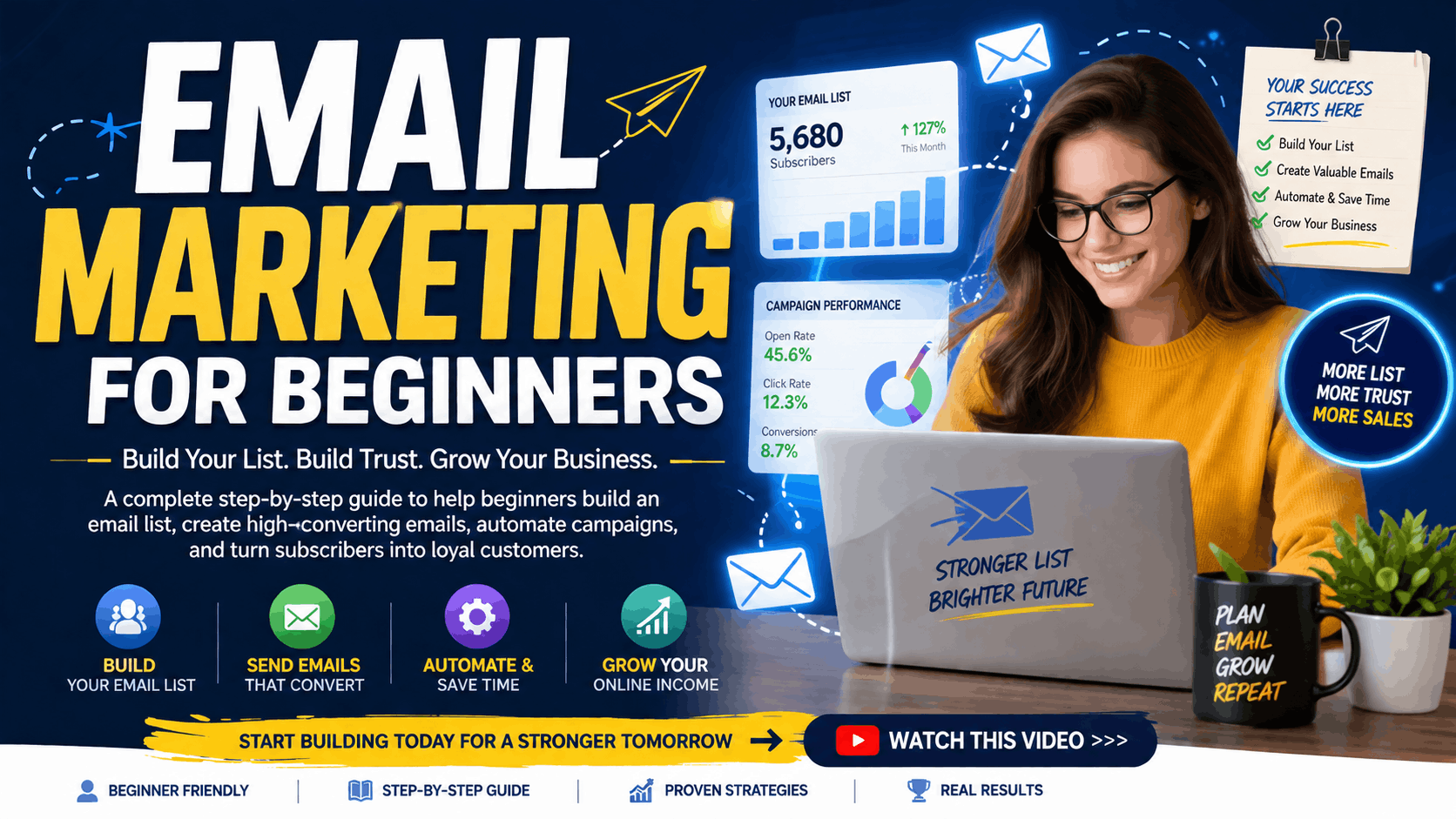
Email Marketing for Beginners is one of the smartest places to start if you want to build a sustainable online business. While social media algorithms change frequently and search engine rankings fluctuate, an email list remains an asset that you own and control.
Whether you’re an affiliate marketer, blogger, content creator, freelancer, or small business owner, email marketing gives you a direct way to communicate with your audience. More importantly, it helps you build trust over time, turning casual visitors into loyal subscribers and, eventually, paying customers.
Many beginners assume email marketing is outdated because of social media and AI. In reality, it continues to deliver one of the highest returns on investment among digital marketing channels. Modern AI tools have made it even easier to write engaging emails, automate campaigns, personalize messages, and analyze performance.
This comprehensive guide explains everything you need to know—from choosing an email platform and building your first subscriber list to writing emails that people actually want to open. By the end, you’ll have a clear roadmap for creating an email marketing system that supports long-term business growth.
To Build Your Email List Today — WATCH THIS VIDEO >>>
TL;DR Summary
If you’re short on time, here’s the essence of this guide:
- Email marketing helps you build direct relationships with your audience.
- Your email list is an asset you own, unlike social media followers.
- Beginners should focus on providing value before promoting products.
- AI can simplify email writing, automation, and personalization.
- Growing a quality list matters more than collecting thousands of inactive subscribers.
- Consistent communication builds trust and improves long-term results.
- Automation saves time while creating a better subscriber experience.
- Tracking metrics helps you improve every campaign.
Key Takeaways
Prioritize earning your subscribers’ trust, as lasting relationships lead to better long-term conversions.
Start building your email list as soon as you launch your online business.
Share educational and helpful content before introducing affiliate offers or products.
Encourage sign-ups with a lead magnet that addresses one clear problem.
Use automation to streamline your workflow while keeping your emails personal.
Write in a friendly, conversational style that connects with your audience.
Review campaign metrics regularly and make improvements based on the results.
Table of Contents
- What Is Email Marketing?
- Why Email Marketing Still Works
- Benefits of Email Marketing
- How Email Marketing Works
- Choosing an Email Marketing Platform
- Building Your First Email List
- Creating a High-Converting Lead Magnet
- Landing Pages Explained
- Writing Emails That Get Opened
- Email Automation for Beginners
- Welcome Email Sequences
- Personalization and Segmentation
- AI for Email Marketing
- Measuring Email Performance
- Common Mistakes to Avoid
- Frequently Asked Questions
- Quick Action Checklist
- Conclusion
What Is Email Marketing?
Email marketing is the process of sending valuable, relevant, and timely messages to people who have voluntarily subscribed to receive updates from you.
Unlike traditional advertising, email marketing focuses on building relationships instead of interrupting potential customers. Subscribers choose to hear from you because they believe your content, recommendations, or expertise can help them.
A typical email marketing strategy may include:
- Educational newsletters
- Product recommendations
- Affiliate offers
- Weekly tips
- Product launches
- Promotions and discounts
- Event announcements
- Customer follow-ups
The goal isn’t simply to send emails—it’s to deliver useful information that keeps your audience engaged.
Why Is Email Marketing Important?
Imagine publishing a great article that attracts thousands of visitors.
If those visitors leave without subscribing, there’s a good chance you’ll never reach many of them again.
An email list changes that.
Every new subscriber becomes someone you can continue helping through valuable content, updates, and carefully selected recommendations.
Instead of relying solely on search engines or social media, you create a direct communication channel with your audience.
How Email Marketing Differs from Social Media
Many beginners focus entirely on platforms like Facebook, Instagram, LinkedIn, Pinterest, or YouTube.
While these platforms are excellent for attracting new audiences, they come with one major limitation—you don’t own them.
Algorithms change.
Organic reach rises and falls.
Accounts can be restricted.
Your email list, however, remains under your control.
Here’s a quick comparison.
| Email Marketing | Social Media |
| You own your subscriber list | Platforms own your followers |
| Direct communication | Algorithm-controlled visibility |
| Personalized messaging | Broad audience broadcasting |
| Higher long-term engagement | Constant competition for attention |
| Stronger relationship building | Short-lived interactions |
| Consistent business asset | Platform-dependent audience |
Using both email marketing and social media together creates a more balanced and resilient marketing strategy.
Why Email Marketing Still Works in the AI Era
Artificial Intelligence has transformed digital marketing, but it hasn’t replaced email marketing. Instead, it has made it more efficient, scalable, and personalized.
AI can help generate subject lines, suggest content ideas, automate follow-up sequences, and analyze campaign performance. Even so, the human element remains essential.
People subscribe because they expect helpful information from a real person or brand—not because they want more automated messages.
The most effective email campaigns combine AI’s efficiency with authentic communication.
AI Makes Email Marketing Smarter
Modern AI tools can assist with tasks such as:
- Drafting newsletters.
- Brainstorming subject lines.
- Personalizing content.
- Recommending send times.
- Segmenting subscribers.
- Improving readability.
- Analyzing campaign performance.
- Creating follow-up sequences.
These capabilities save time while allowing you to focus on building stronger relationships with your audience.
Trust Is Still the Biggest Competitive Advantage
Subscribers are more likely to open emails from creators they trust.
You build that trust by:
- Sharing honest advice.
- Solving real problems.
- Recommending products responsibly.
- Writing in a conversational tone.
- Being consistent with your communication.
Technology can improve efficiency, but genuine trust continues to drive long-term success.
Benefits of Email Marketing
Email marketing offers advantages that few other digital marketing channels can match.
Build Long-Term Relationships
Every email creates another opportunity to strengthen your connection with subscribers.
Rather than focusing solely on sales, you can educate, inspire, and help your audience solve meaningful problems.
Increase Website Traffic
Each newsletter provides an opportunity to direct readers toward:
- New blog posts.
- Product reviews.
- Tutorials.
- Videos.
- Case studies.
- Special offers.
Regular emails encourage repeat visits and greater engagement with your content.
Generate Consistent Affiliate Income
Affiliate promotions often perform better when subscribers already trust your recommendations.
Instead of relying on one-time visitors, you nurture relationships over time before introducing relevant products.
Automate Your Marketing
Automation allows you to deliver the right message at the right time without manually sending every email.
Examples include:
- Welcome emails.
- Educational sequences.
- Product recommendations.
- Re-engagement campaigns.
- Follow-up messages.
Automation improves consistency while reducing repetitive work.
Gain Valuable Insights
Most email marketing platforms provide analytics that help you understand subscriber behavior.
Useful metrics include:
- Open rates.
- Click-through rates.
- Subscriber growth.
- Unsubscribe rates.
- Conversion performance.
Reviewing these metrics helps you continuously improve your campaigns.
Pros and Cons of Email Marketing
| Pros | Cons |
| Direct access to your audience | Building a quality list takes time |
| High return on investment | Requires consistent communication |
| You own your subscriber list | Poorly written emails may be ignored |
| Easy to automate | Inbox competition can affect visibility |
| Supports affiliate marketing effectively | Needs regular testing and optimization |
| Builds trust over time | Success doesn’t happen overnight |
While email marketing requires patience, its long-term benefits often outweigh the initial effort.
💡 Expert Tip
Don’t start your email list after your website grows—start it from day one. Even if only a handful of visitors subscribe each week, those relationships can become one of your most valuable business assets over time.
📌 Pro Tip
Instead of asking, “How can I sell something today?”
Ask yourself:
“What valuable information can I share today that makes subscribers look forward to my next email?”
That simple mindset shift can dramatically improve engagement and build stronger trust with your audience.
How Email Marketing Works (Step by Step)
At first glance, email marketing may seem complicated. However, the process follows a simple cycle that anyone can learn.
The objective isn’t to send as many emails as possible. Instead, you want to attract the right people, provide valuable content, and build enough trust that your recommendations feel helpful rather than promotional.
Here’s a simplified workflow.
Visitor → Subscriber → Trust → Value → Recommendation → Customer → Loyal Subscriber
Each stage plays an important role in building a sustainable email marketing strategy.
Step 1: Attract Visitors
Everything begins with traffic.
People first discover your content through channels such as:
- Google Search
- AI Search Engines
- YouTube
- X (Twitter)
- Quora
- Medium
- Blog referrals
Your goal at this stage isn’t to make a sale.
Instead, focus on providing helpful content that encourages visitors to learn more.
Step 2: Capture Email Subscribers
Once someone visits your website, offer a compelling reason to subscribe.
This usually happens through a lead magnet.
Examples include:
- Free eBook
- Beginner’s checklist
- AI prompt library
- Affiliate marketing guide
- SEO checklist
- Video training
- Resource toolkit
- Free email course
A valuable lead magnet solves one specific problem quickly.
Step 3: Build Trust
After someone joins your list, avoid promoting products immediately.
Instead, provide useful information that helps subscribers achieve small wins.
You might send:
- Weekly tutorials
- Actionable tips
- Industry updates
- Helpful tools
- Success stories
- Common mistakes to avoid
Trust grows through consistency, not constant promotion.
Step 4: Recommend Helpful Products
Once you’ve demonstrated your expertise, subscribers are far more likely to consider your recommendations.
Whenever you promote an affiliate product:
- Explain who it’s designed for.
- Highlight both strengths and limitations.
- Share practical use cases.
- Recommend alternatives if appropriate.
Honest recommendations strengthen long-term credibility.
Step 5: Repeat the Process
Email marketing isn’t a one-time campaign.
Continue providing value, learning from subscriber feedback, and improving your communication.
Over time, this creates stronger relationships and more consistent affiliate income.
Choosing the Best Email Marketing Platform
Your email marketing platform serves as the control center for your campaigns.
While every platform offers different features, beginners should prioritize simplicity, reliability, and room to grow.
Features to Look For
Before choosing a platform, consider whether it offers:
- Beginner-friendly interface.
- Email automation.
- Landing page builder.
- Subscriber segmentation.
- Analytics dashboard.
- Mobile-responsive templates.
- AI-assisted writing features.
- Integration with your website.
Selecting a platform that matches your current needs makes the learning process much easier.
Compare Popular Platform Types
| Platform Type | Best For | Main Advantage |
| Beginner-Friendly | New marketers | Easy setup and simple automation |
| Creator-Focused | Bloggers and content creators | Newsletter and audience engagement |
| E-commerce | Online stores | Product-focused automation |
| Advanced Marketing | Growing businesses | Powerful segmentation and workflows |
Rather than searching for the “perfect” platform, choose one that allows you to start building your list confidently.
Start Simple
Many beginners delay taking action because they’re overwhelmed by comparisons.
Remember:
A good platform that you actively use will always outperform an advanced platform you never fully implement.
To Build Your Email List Today — WATCH THIS VIDEO >>>
Building Your First Email List
One of the biggest misconceptions in digital marketing is that you need thousands of subscribers before email marketing becomes effective.
In reality, a small, engaged audience often produces better results than a large list of inactive contacts.
Quality always beats quantity.
Where Should You Collect Subscribers?
Your website provides several opportunities to encourage sign-ups.
Examples include:
- Homepage
- Blog sidebar
- End of articles
- Landing pages
- Resource pages
- Pop-up forms
- Exit-intent forms
- About page
Avoid overwhelming visitors with too many subscription requests.
Instead, place forms naturally where they provide value.
Offer a Clear Benefit
People rarely subscribe just because a form says:
“Join My Newsletter.”
Instead, explain exactly what they’ll receive.
Examples include:
- Learn affiliate marketing step by step.
- Receive weekly AI marketing tips.
- Download a free SEO checklist.
- Get exclusive tutorials every Friday.
- Access beginner-friendly marketing resources.
The clearer your value proposition, the higher your subscription rate is likely to be.
Build Trust Before Asking
Visitors are more likely to subscribe when they already perceive your content as valuable.
You can strengthen confidence by:
- Publishing in-depth articles.
- Sharing practical examples.
- Displaying testimonials when available.
- Being transparent about affiliate relationships.
- Maintaining a professional website.
Trust encourages action.
Creating an Irresistible Lead Magnet
A lead magnet is something valuable you give away in exchange for an email address.
The best lead magnets solve one specific problem quickly.
Characteristics of an Effective Lead Magnet
Your lead magnet should be:
- Easy to understand.
- Immediately useful.
- Highly relevant to your niche.
- Quick to consume.
- Focused on one topic.
Instead of creating a lengthy course, solve a single problem exceptionally well.
Lead Magnet Ideas
For affiliate marketing beginners, consider offering:
| Lead Magnet | Audience Benefit |
| AI Prompt Library | Save time creating content |
| Affiliate Marketing Checklist | Avoid beginner mistakes |
| SEO Starter Guide | Improve search visibility |
| Content Planning Template | Stay organized |
| Email Swipe File | Learn effective email writing |
| Free Mini Course | Gain foundational knowledge |
| Resource Toolkit | Access recommended tools quickly |
Choose a lead magnet that naturally connects to the products or services you may recommend later.
Keep It Actionable
Subscribers appreciate resources they can apply immediately.
For example, instead of creating:
“The Ultimate Guide to Digital Marketing”
Create something more focused like:
“10 AI Prompts That Help Affiliate Marketers Write Better Blog Posts.”
Specific solutions often outperform broad resources.
Designing High-Converting Landing Pages
A landing page has one primary objective:
Encourage visitors to take one specific action.
Unlike a homepage, a landing page removes unnecessary distractions.
Essential Elements
A strong landing page typically includes:
- Clear headline.
- Supporting subheading.
- Benefit-focused copy.
- Visual representation of the lead magnet.
- Short subscription form.
- Call-to-action button.
- Trust indicators.
Every element should guide visitors toward subscribing.
Keep Forms Short
The more information you request, the lower your conversion rate may become.
For most beginners, asking only for:
- First name (optional)
- Email address
is sufficient.
Reducing friction encourages more people to join your list.
Focus on Benefits
Instead of describing features, explain how subscribers will benefit.
For example:
❌ Receive weekly newsletters.
✅ Learn practical affiliate marketing strategies that save time and increase productivity.
Benefits motivate action.
Common Beginner Mistakes to Avoid
Learning what not to do can be just as valuable as learning best practices.
Avoid these common mistakes.
Buying Email Lists
Purchased email lists rarely produce quality results.
Subscribers should willingly choose to receive your emails.
Permission-based marketing builds stronger relationships and protects your sender reputation.
Sending Too Many Promotions
Constantly promoting affiliate products can reduce trust.
Aim to educate first and promote naturally when recommendations genuinely help your audience.
Ignoring Mobile Readers
Many subscribers read emails on smartphones.
Use:
- Short paragraphs.
- Clear headings.
- Readable fonts.
- Simple layouts.
- Mobile-friendly formatting.
A positive mobile experience improves engagement.
Inconsistent Communication
Long gaps between emails can cause subscribers to forget who you are.
Create a realistic schedule you can maintain consistently.
Whether you send one email each week or two emails each month, consistency matters more than frequency.
Not Testing Campaigns
Small improvements can significantly impact performance.
Experiment with:
- Subject lines.
- Calls-to-action.
- Send times.
- Email length.
- Button placement.
Testing helps you discover what resonates with your audience.
💡 Expert Tip
Your first goal isn’t building a list of 10,000 subscribers. It’s earning the trust of your first 100 subscribers. Those early relationships will teach you far more than any marketing course.
📌 Pro Tip
Whenever you create a new blog post, ask yourself:
“Can this article include a lead magnet that solves the reader’s next problem?”
This simple habit turns your content into a consistent subscriber-generation system.
Absolutely! Based on your saved workflow, we’ll continue the Email Marketing for Beginners article.
Writing High-Converting Emails That People Want to Read
Building an email list is only the first step. The real value comes from sending emails that subscribers look forward to opening.
Many beginners believe successful email marketing depends on clever sales tactics. In reality, the most effective emails focus on helping people solve problems, answer questions, and make informed decisions.
When subscribers consistently receive useful information, trust grows naturally. That trust often leads to higher engagement and better conversion rates over time.
Start with an Engaging Subject Line
Your subject line creates the first impression.
Even the most valuable email may go unread if the subject line doesn’t capture attention.
Aim to write subject lines that are:
- Clear rather than confusing.
- Specific instead of vague.
- Honest without exaggeration.
- Curiosity-driven but not misleading.
- Relevant to the reader’s interests.
Examples
| Weak Subject Line | Improved Subject Line |
| Newsletter #12 | 7 Email Marketing Mistakes Beginners Should Avoid |
| AI Tips | How AI Can Help You Write Better Emails in Less Time |
| New Blog Post | New Guide: Build Your First Email List Step by Step |
| Marketing Advice | One Simple Email Strategy That Builds Long-Term Trust |
A strong subject line encourages subscribers to open your email because they expect to learn something valuable.
Write Like You’re Talking to One Person
One of the biggest mistakes beginners make is writing as though they’re addressing a crowd.
Instead, imagine writing to a single subscriber.
Use conversational language.
Keep sentences natural.
Explain ideas clearly.
Readers connect more easily with emails that feel personal rather than corporate.
Focus on One Primary Goal
Every email should have one clear objective.
For example:
- Teach one concept.
- Solve one problem.
- Recommend one helpful tool.
- Invite readers to one article.
- Promote one relevant affiliate product.
Trying to accomplish too many things in a single email often reduces effectiveness.
Follow a Simple Email Structure
A consistent structure makes your emails easier to read.
1. Greeting
Welcome your reader naturally.
2. Hook
Capture attention immediately.
Ask a question.
Share a surprising fact.
Describe a common problem.
3. Valuable Content
Teach something useful.
Provide practical advice.
Share an experience.
Offer actionable steps.
4. Call-to-Action
End with one clear next step.
Examples include:
- Read the article.
- Watch the tutorial.
- Download the checklist.
- Try the recommended tool.
A focused CTA improves click-through rates.
Email Copywriting Tips That Improve Engagement
Good copywriting isn’t about sounding persuasive.
It’s about communicating clearly and helping readers make informed decisions.
Keep Paragraphs Short
Large blocks of text discourage reading.
Instead:
- Write 2–4 sentence paragraphs.
- Use bullet lists.
- Break up long explanations.
- Highlight important ideas with headings.
This improves readability, especially on mobile devices.
Tell Stories
Stories make information memorable.
For example, instead of saying:
Building an email list is important.
Explain how consistent email communication helped a business increase engagement over several months.
Real-world examples create stronger connections than abstract advice.
Use Simple Language
Avoid unnecessary jargon.
If a beginner needs to search for the meaning of every second word, the email becomes difficult to follow.
Simple writing often performs better because it’s easier to understand.
End with a Clear CTA
Never leave readers wondering what to do next.
Your CTA should be:
- Specific.
- Relevant.
- Easy to follow.
For example:
Dive into the complete guide for step-by-step instructions.
Grab your free checklist to stay organized.
Follow the tutorial and apply what you learn.
Discover the recommended tool to simplify your workflow.
Welcome Email Sequences
The first few emails often determine whether subscribers remain engaged.
A welcome sequence introduces new subscribers to your brand while setting expectations.
To Build Your Email List Today — WATCH THIS VIDEO >>>
Why Welcome Emails Matter
Subscribers are usually most engaged immediately after joining your list.
This creates an excellent opportunity to:
- Deliver the promised lead magnet.
- Introduce yourself.
- Share valuable resources.
- Explain what subscribers can expect.
- Begin building trust.
Example Welcome Sequence
| Day | Email Purpose |
| Day 1 | Welcome, introduce yourself, deliver lead magnet |
| Day 2 | Share your best beginner resource |
| Day 4 | Teach a valuable strategy |
| Day 6 | Recommend a useful free tool |
| Day 8 | Share a case study or success story |
| Day 10 | Introduce a relevant affiliate product naturally |
Each email should build upon the previous one rather than repeating the same message.
Broadcast Emails vs Automated Emails
Both types of emails play important roles.
Understanding the difference helps you build a more effective strategy.
| Broadcast Emails | Automated Emails |
| Sent manually | Triggered automatically |
| Newsletters | Welcome sequences |
| Weekly updates | Follow-up campaigns |
| Promotions | Educational courses |
| Product launches | Lead nurturing |
Most successful email marketers combine both approaches.
Automation provides consistency.
Broadcast emails keep subscribers informed about current updates.
Personalization and Segmentation
Every subscriber has different interests.
Sending identical emails to everyone often reduces engagement.
Segmentation helps deliver more relevant content.
Segment by Interest
For example:
- Affiliate Marketing
- Blogging
- SEO
- AI Tools
- Email Marketing
- YouTube Marketing
- Pinterest Marketing
Subscribers receive content aligned with their interests.
Segment by Experience
You might separate subscribers into:
- Beginners.
- Intermediate marketers.
- Advanced marketers.
This allows you to adjust the depth of your content.
Personalization
Simple personalization can include:
- Subscriber name.
- Relevant recommendations.
- Previous interests.
- Past downloads.
Personalized emails often feel more engaging because they reflect the subscriber’s needs.
How AI Improves Email Marketing
Artificial Intelligence has become a valuable assistant for email marketers.
Rather than replacing creativity, AI helps streamline repetitive tasks.
AI Can Help You
- Brainstorm newsletter ideas.
- Draft email outlines.
- Improve subject lines.
- Rewrite copy for clarity.
- Personalize messages.
- Analyze campaign performance.
- Suggest follow-up sequences.
- Generate calls-to-action.
These capabilities allow you to spend more time creating value for your audience.
Use AI Responsibly
AI should support your workflow—not replace your judgment.
Before sending any campaign:
- Review every email.
- Verify facts.
- Add personal insights.
- Maintain your unique voice.
- Ensure recommendations remain honest and helpful.
Combining AI with human expertise creates stronger email campaigns.
Email Writing Formula for Beginners
A simple framework can make writing easier.
Problem
Identify a challenge your audience faces.
↓
Solution
Offer practical advice or a useful strategy.
↓
Example
Demonstrate how it works.
↓
Action
Invite readers to take one clear next step.
This structure keeps emails focused and actionable.
💡 Expert Tip
If subscribers consistently learn something valuable from your emails, they’ll be far more receptive when you occasionally recommend an affiliate product. Value builds trust, and trust supports long-term conversions.
📌 Pro Tip
Before sending any email, ask yourself:
“Would I still send this email if it contained no affiliate links?”
If the answer is yes, you’re likely creating content that genuinely serves your audience.
If the answer is no, consider adding more educational value before hitting send.
Growing Your Email List Faster
Building an email list doesn’t happen overnight. It grows through consistent effort, valuable content, and a clear reason for people to subscribe.
Instead of chasing large subscriber numbers, focus on attracting readers who are genuinely interested in your niche. A smaller, engaged list often delivers better results than a large list of inactive subscribers.
The strategies below can help you grow your email list steadily while maintaining quality.
Publish Helpful Content Consistently
Every blog post, video, or social media update is an opportunity to gain new subscribers.
Create content that answers common questions, solves specific problems, and encourages readers to continue learning through your email list.
The more value you provide, the more likely visitors are to subscribe.
Offer Multiple Lead Magnets
Different visitors have different needs.
Instead of relying on a single free resource, create several lead magnets tailored to your audience.
Examples include:
- Beginner guides
- Checklists
- Templates
- AI prompt collections
- Email swipe files
- Mini courses
- Resource libraries
- Video tutorials
Giving readers options increases the likelihood that they’ll find something relevant.
Add Subscription Opportunities Throughout Your Website
Make it easy for visitors to join your email list.
Effective locations include:
- Homepage hero section
- Blog sidebar
- End of articles
- Resource pages
- About page
- Exit-intent pop-ups
- Floating subscription bars
Avoid overwhelming visitors with too many forms. Instead, place them naturally where they complement the content.
Repurpose Content Across Multiple Platforms
One high-quality article can support your email list in many ways.
For example, you can transform a single blog post into:
- A YouTube video
- Several Pinterest Pins
- A LinkedIn article
- An X thread
- A Facebook post
- An Instagram carousel
- Short-form videos
Each platform can direct interested readers back to your website, where they have the opportunity to subscribe.
Measuring Email Marketing Performance
Sending emails is only part of the process. Reviewing performance helps you understand what’s working and where improvements are needed.
Rather than relying on assumptions, use data to guide your decisions.
Key Metrics to Monitor
The following metrics provide valuable insights into campaign performance.
| Metric | Why It Matters |
| Open Rate | Indicates how effective your subject lines are. |
| Click-Through Rate (CTR) | Measures how many readers clicked your links. |
| Conversion Rate | Shows how many subscribers completed the desired action. |
| Subscriber Growth | Tracks the expansion of your email list. |
| Unsubscribe Rate | Helps identify content that may not meet subscriber expectations. |
| Bounce Rate | Highlights issues with email deliverability. |
Monitoring these metrics regularly allows you to refine your strategy over time.
Test and Improve
Successful email marketers continuously experiment.
Consider testing:
- Subject lines
- Send times
- Email length
- Call-to-action buttons
- Images
- Personalization
- Content formats
Even small adjustments can lead to meaningful improvements.
Email Marketing Best Practices
Following proven best practices helps create a positive experience for your subscribers.
Prioritize Value
Every email should educate, inform, or solve a problem.
When readers consistently benefit from your emails, they are more likely to remain engaged and trust your recommendations.
Be Consistent
Choose a realistic publishing schedule.
Examples include:
- Weekly newsletters
- Bi-weekly educational emails
- Monthly updates
Consistency builds familiarity and keeps your audience connected.
Keep Your List Healthy
Regularly review your subscriber list.
Remove inactive contacts when appropriate and encourage engagement through valuable content.
A healthy list often performs better than a larger list with low engagement.
Continue Learning
Email marketing evolves alongside technology.
Stay informed about:
- AI advancements
- Privacy regulations
- Deliverability best practices
- Content trends
- Subscriber preferences
Continuous learning helps you adapt and improve.
Common Mistakes to Avoid
Even experienced marketers make mistakes from time to time.
Recognizing these challenges early can help you avoid unnecessary setbacks.
Avoid:
- Waiting too long to start building your email list.
- Promoting products before establishing trust.
- Sending inconsistent emails.
- Ignoring subscriber feedback.
- Writing misleading subject lines.
- Neglecting mobile optimization.
- Failing to review campaign performance.
- Overusing AI without adding human insight.
- Asking for too much information on subscription forms.
- Treating every email as a sales pitch.
Building relationships should always come before making recommendations.
Frequently Asked Questions (People Also Ask)
Is email marketing worth learning for beginners?
Yes. Email marketing remains one of the most effective ways to build long-term relationships with your audience while supporting affiliate marketing, blogging, and online business growth.
How often should beginners send emails?
A consistent schedule is generally more important than frequent communication. Many beginners find that one helpful email each week is a practical starting point.
Can I use AI to write my emails?
Yes. AI can assist with brainstorming, drafting, editing, and personalization. However, reviewing the content and adding your own perspective helps maintain authenticity.
How many subscribers do I need before promoting affiliate products?
There’s no fixed number. Focus on earning your subscribers’ trust first. A small, engaged audience often performs better than a much larger list with limited engagement.
Should I build an email list even if I use social media?
Absolutely. Social media helps attract new visitors, while an email list gives you a direct communication channel that isn’t controlled by platform algorithms.
Quick Action Checklist
Before launching your email marketing strategy, review this checklist.
Here’s a completely different style and structure that avoids repetitive “verb + object” patterns while keeping the content clear and engaging.
Quick Action Checklist
Before launching your email marketing strategy, make sure you’ve covered these essentials:
Build lasting trust by educating and helping your audience before introducing affiliate offers or promotions.
Select an email marketing service that aligns with your business goals and budget.
Develop a free resource that encourages visitors to join your mailing list.
Set up a dedicated landing page designed to convert visitors into subscribers.
Place opt-in forms strategically throughout your website to maximize sign-ups.
Prepare an automated welcome series that introduces your brand and delivers immediate value.
Maintain a regular publishing schedule to keep your audience informed and engaged.
Expand your subscriber base by promoting your content across multiple traffic channels.
Track important campaign metrics to understand subscriber behavior and campaign performance.
Use the insights you gather to refine your emails and improve future results.
Build lasting trust by educating and helping your audience before introducing affiliate offers or promotions.
Final Thoughts
Building a successful email marketing system doesn’t require a massive audience or years of experience. What matters most is consistency, authenticity, and a genuine desire to help your subscribers.
Every valuable email strengthens your relationship with your audience. Over time, those relationships can become one of the most important assets in your online business.
Artificial Intelligence makes many tasks easier, but meaningful communication still depends on your ability to understand your audience and provide useful solutions.
Keep learning, keep improving, and focus on serving your subscribers well.
Key Takeaways
- Email Marketing for Beginners is one of the most reliable long-term digital marketing strategies.
- Your email list is an asset you own and control.
- Build trust before recommending affiliate products.
- Create lead magnets that solve specific problems.
- Use AI to improve productivity while maintaining your personal voice.
- Measure performance and optimize campaigns regularly.
- Repurpose content to grow your subscriber base.
- Consistency often delivers better results than occasional bursts of activity.
- Continue learning as technology and subscriber expectations evolve.
- Focus on helping people first, and business growth is more likely to follow.
Conclusion
Email Marketing for Beginners offers much more than a way to send newsletters. It provides an opportunity to build lasting relationships, establish credibility, and create a dependable communication channel with your audience.
Whether your goal is to grow an affiliate marketing business, promote a blog, or expand an online brand, email marketing gives you a foundation that can support long-term success.
To Build Your Email List Today — WATCH THIS VIDEO >>>
Start with the basics. Build your list one subscriber at a time. Share valuable content consistently. Refine your strategy as you learn.
Every email you send is another opportunity to educate, inspire, and earn trust.
The best time to begin building your email list is today.
Helping beginners master Email Marketing with practical strategies, AI-powered tools, and proven systems to build engaged email lists, increase conversions, and grow sustainable online income.
“Your email list isn’t just a marketing tool—it’s the most valuable business asset you’ll ever own.”