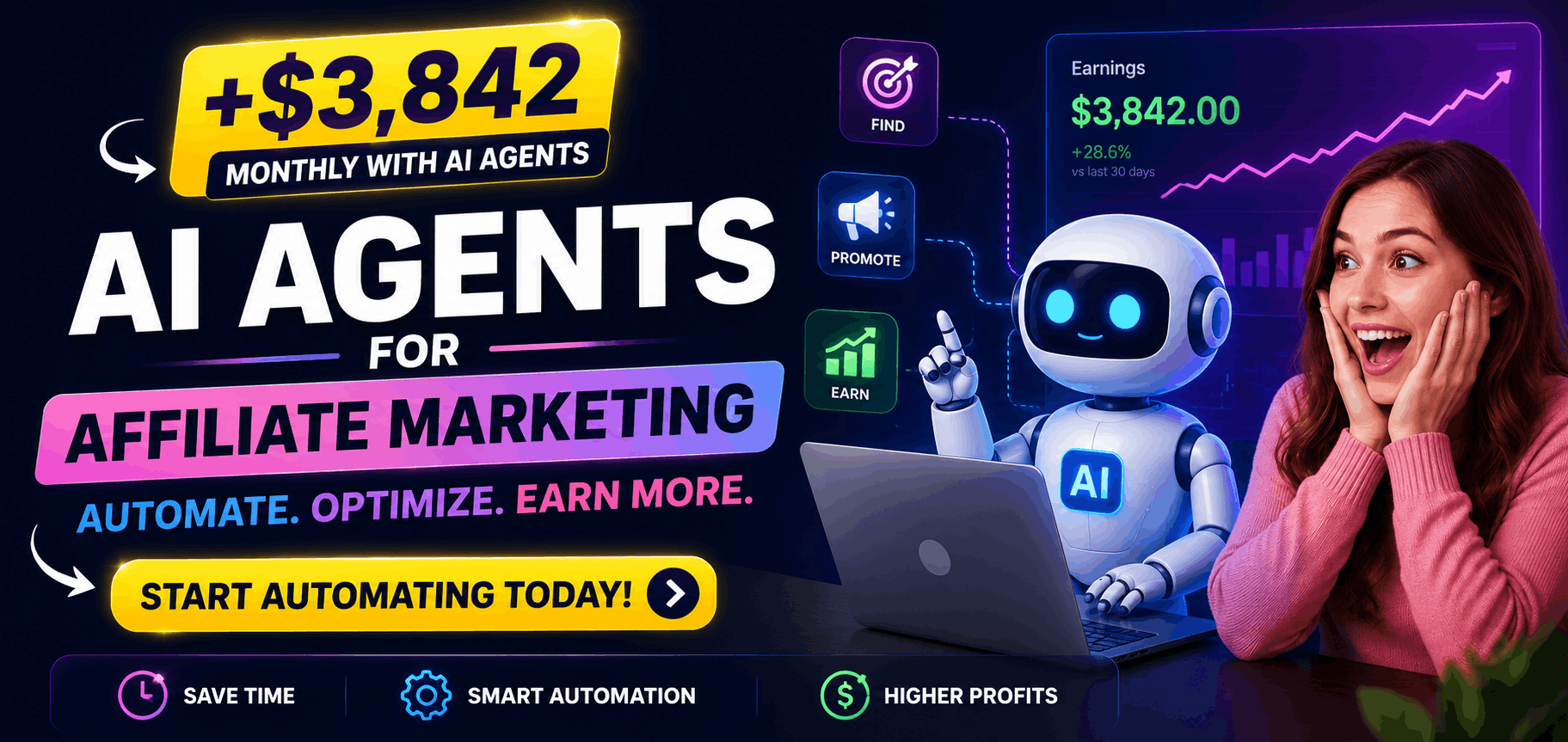
Affiliate marketing is becoming less about doing more work and more about building systems that can do the repetitive work for you. That is where AI agents for affiliate marketing are starting to change the game.
Unlike basic AI tools that simply generate text or answer prompts, AI agents can be designed to handle connected tasks such as researching affiliate niches, analyzing keywords, monitoring competitors, creating content, tracking campaigns, and identifying opportunities for optimization.
The real opportunity isn’t to let AI randomly automate your entire business. It’s to build a smarter affiliate marketing workflow where AI agents handle time-consuming tasks while you focus on strategy, offer selection, audience trust, and conversions.
In this article, we’ll explore how AI agents can automate affiliate campaigns, which tasks are worth delegating to them, how they can support SEO and content, and how to build an AI-powered affiliate marketing system designed for scalable growth.
Want to see how AI can transform your affiliate marketing strategy? <<< WATCH THIS FREE VIDEO TO START NOW >>>
TL;DR Summary
AI agents for affiliate marketing can automate repetitive campaign tasks such as keyword research, competitor analysis, content planning, SEO optimization, lead nurturing, campaign monitoring, and conversion analysis.
The biggest advantage isn’t simply saving time. It’s creating a connected marketing system that can research faster, publish smarter, monitor performance, and continuously improve campaigns.
Instead of using AI as just a content generator, affiliate marketers can use AI agents as specialized digital assistants working across different parts of the marketing funnel.
The core idea: Let AI agents handle repetitive execution while you focus on strategy, audience trust, profitable offers, and growth.
Key Takeaways
- AI agents can automate repetitive affiliate marketing tasks such as research, content planning, SEO analysis, campaign monitoring, and reporting.
- AI agents go beyond ordinary AI tools by connecting multiple tasks and executing workflows with less manual intervention.
- Affiliate content can become more data-driven when AI agents analyze search intent, competitors, keywords, content gaps, and audience behavior.
- Automation can improve campaign efficiency by helping marketers identify weak pages, missed opportunities, and conversion bottlenecks faster.
- AI agents can support the entire affiliate funnel—from niche and offer research to content, traffic generation, lead nurturing, and conversion optimization.
- Human strategy still matters. AI should handle repetitive execution while you control positioning, recommendations, trust, compliance, and final decisions.
- The strongest approach is an AI-powered system, not a collection of disconnected tools. The goal is to make your affiliate marketing workflow smarter, faster, and easier to scale.
What Are AI Agents for Affiliate Marketing and How Do They Work?
AI agents for affiliate marketing are AI-powered systems designed to perform specific marketing tasks with limited human intervention. Unlike a standard AI chatbot that waits for a prompt, an AI agent can follow a defined objective, use connected tools or data, complete multiple tasks, and report the results.
For affiliate marketers, this means moving from “AI helps me create content” to “AI helps me operate the campaign.”
What Can an AI Agent Do for Affiliate Marketing?
A well-designed AI agent can handle repetitive activities such as:
- Affiliate niche research — identify profitable topics, audiences, and market gaps.
- Keyword research — discover search terms, related queries, and content opportunities.
- Competitor analysis — examine competing content and identify potential gaps.
- Content planning — turn keywords and search intent into article or video ideas.
- SEO optimization — analyze titles, headings, internal links, and topical relevance.
- Affiliate offer research — evaluate products based on audience fit, commission structure, and recurring potential.
- Campaign monitoring — track important traffic, clicks, conversions, and performance signals.
- Conversion optimization — identify pages or campaigns that may need better CTAs, offers, or messaging.
The important point is that AI agents should have specific jobs. One agent might specialize in SEO research while another monitors campaign performance.
How AI Agents Work in an Affiliate Campaign
A simple AI affiliate marketing workflow looks like this:
Goal → Research → Decision → Action → Monitor → Optimize
For example, you could give an AI agent the objective of finding new content opportunities for an affiliate website. It could analyze your target topic, research relevant search queries, identify content gaps, recommend article topics, and organize the results for your review.
More advanced setups can connect AI agents with SEO platforms, analytics tools, spreadsheets, content systems, email platforms, and automation software.
AI Agents vs. Traditional AI Tools
The difference is mainly workflow and autonomy.
A traditional AI tool generally responds to individual instructions:
“Give me 20 affiliate keyword ideas.”
An AI agent can be assigned a broader objective:
“Find new affiliate content opportunities, analyze the competition, prioritize the strongest topics, and prepare a content plan.”
That makes AI agents particularly useful for affiliate marketing automation, where several connected tasks need to happen repeatedly.
The Best Way to Use AI Agents
Don’t try to automate everything immediately. Start with high-volume, repetitive tasks where AI can save time without controlling important business decisions.
Keep human oversight for:
- Choosing affiliate products
- Reviewing factual claims
- Adding personal experience and expertise
- Checking affiliate disclosures
- Approving published content
- Making major budget and campaign decisions
The strategic advantage is simple: AI agents handle repetitive execution while you concentrate on strategy, trust, profitable offers, and conversions.
How AI Agents Automate Affiliate Marketing Campaigns
AI agents can automate affiliate marketing campaigns by connecting research, content, promotion, monitoring, and optimization into one repeatable workflow. Instead of manually performing every task, marketers can assign specific objectives to AI agents and review the results before important actions are taken.
The goal isn’t full automation. The goal is smarter affiliate marketing automation with human oversight.
1. Automate Affiliate Niche and Keyword Research
An AI agent can continuously research:
- High-intent affiliate keywords
- Long-tail search queries
- Trending topics
- Competitor content gaps
- Related questions and search intent
- Potential content opportunities
This helps create a steady pipeline of SEO-focused affiliate content ideas instead of researching keywords manually every time.
2. Automate Affiliate Content Planning
Once opportunities are identified, an AI agent can turn them into a structured content plan.
It can recommend:
- SEO titles
- H2 and H3 topics
- Search intent
- Related keywords
- Internal linking opportunities
- Affiliate CTA placements
- Content updates
You still control the final angle and recommendations, but the repetitive planning work becomes much faster.
3. Automate Campaign Monitoring
After publishing content or launching an affiliate campaign, AI agents can monitor important performance signals.
For example:
Traffic → Affiliate Clicks → Conversions → Revenue
An agent can flag unusual changes, identify underperforming pages, and highlight campaigns that deserve attention.
This is especially useful when managing multiple affiliate offers or content channels.
4. Automate Affiliate Conversion Optimization
AI agents can analyze campaign data to identify potential conversion problems.
They can help evaluate:
- Weak calls to action
- Poor-performing landing pages
- Low affiliate click-through rates
- Content-to-offer mismatches
- Underperforming traffic sources
Instead of guessing what needs improvement, you can use campaign data to prioritize your next optimization.
5. Create a Connected AI Affiliate Workflow
The real power appears when individual tasks work together:
Keyword Research → Content Planning → Content Creation → SEO → Promotion → Tracking → Optimization
This creates a repeatable AI-powered affiliate marketing system rather than a collection of disconnected AI tools.
What Should You Automate?
Prioritize tasks that are repetitive, measurable, and time-consuming.
Keep humans responsible for strategic decisions such as choosing trustworthy affiliate products, reviewing recommendations, verifying claims, maintaining compliance, and protecting audience trust.
The winning strategy isn’t “automate everything.” It’s to automate the repetitive work while keeping humans in control of the decisions that directly affect revenue and credibility.
Best AI Agent Tasks for Affiliate Marketing
The best AI agent tasks for affiliate marketing are those that are repetitive, data-heavy, and easy to measure. Instead of asking one AI tool to do everything, you can assign specialized tasks to AI agents and connect them into a larger workflow.
Here are the most valuable tasks to prioritize.
1. Affiliate Keyword Research
AI agents can continuously identify:
- High-intent affiliate keywords
- Long-tail search terms
- Related questions
- Commercial search queries
- Content gaps
- Emerging topic opportunities
This can help maintain a consistent pipeline of SEO keywords for affiliate marketing.
2. Competitor and Content Gap Analysis
An AI agent can analyze competing pages to identify:
- Topics competitors cover
- Missing subtopics
- Search intent
- Content weaknesses
- Potential opportunities for differentiation
The goal isn’t to copy competitors. It’s to discover where your content can provide more useful and relevant information.
3. Affiliate Content Planning
AI agents can turn keyword research into a practical content calendar.
They can suggest:
Keyword → Search Intent → SEO Title → H2 Structure → Supporting Topics → CTA
This reduces repetitive research and helps create a more organized affiliate content strategy.
4. SEO Content Optimization
An AI SEO agent can review existing affiliate content for:
- Keyword relevance
- Search intent
- Heading structure
- Internal linking
- Semantic topics
- Content gaps
- Meta titles and descriptions
This is particularly useful for updating older affiliate articles instead of constantly publishing new ones.
5. Affiliate Offer Research
AI agents can help organize and compare potential affiliate offers based on factors such as:
- Product relevance
- Target audience
- Commission structure
- Recurring commissions
- Product positioning
- Customer demand
However, the final offer selection should remain a human decision because commission alone doesn’t determine whether an offer is worth promoting.
6. Affiliate Campaign Monitoring
Once campaigns are running, AI agents can monitor key signals such as:
Traffic → Clicks → Conversions → Revenue
They can identify unusual changes and bring underperforming campaigns or pages to your attention.
7. Conversion Optimization
AI agents can analyze performance data and suggest improvements to:
- Affiliate CTAs
- Product comparisons
- Landing pages
- Content-to-offer alignment
- Call-to-action placement
- Conversion-focused messaging
This allows marketers to focus optimization efforts where they are most likely to matter.
8. Content and Campaign Updates
AI agents can monitor existing content and flag pages that may need attention because of:
- Outdated information
- Declining traffic
- New competitors
- Changed affiliate offers
- New keyword opportunities
This creates an ongoing affiliate marketing automation cycle rather than a publish-and-forget strategy.
The Highest-Value AI Agent Tasks
If you want to keep your system lean, prioritize these five:
Keyword Research → Competitor Analysis → Content Planning → Campaign Monitoring → Conversion Optimization
Want to see how AI can transform your affiliate marketing strategy? <<< WATCH THIS FREE VIDEO TO START NOW >>>
These tasks combine SEO, automation, traffic, and revenue optimization without trying to automate every part of your affiliate business.
The smartest approach is to let AI agents handle repetitive analysis and execution while you remain responsible for strategy, product selection, content quality, compliance, and audience trust.
How to Use AI Agents for Affiliate Content and SEO
AI agents can make affiliate content and SEO more efficient by connecting keyword research, search-intent analysis, content planning, optimization, and performance monitoring. The objective isn’t to publish unlimited AI-generated articles. It’s to build a system that consistently finds opportunities and helps improve useful content.
1. Find High-Intent Affiliate Keywords
An AI agent can analyze your niche and identify keywords based on search intent, including:
- Commercial keywords
- Comparison keywords
- Product-related searches
- Problem-solving queries
- Long-tail affiliate keywords
- Related questions
Prioritize keywords where the searcher has a clear reason to research, compare, or purchase a product.
2. Analyze Search Intent and Content Gaps
Before creating an article, an AI agent can examine the type of content already ranking and determine what searchers actually want.
It can identify:
Search Intent → Existing Topics → Missing Information → Content Opportunity
This helps you create affiliate content that answers the query more completely instead of producing another generic AI article.
3. Build SEO-Friendly Affiliate Content
AI agents can assist with the content structure by creating:
- SEO titles
- H2 and H3 outlines
- FAQs
- Semantic keyword suggestions
- Internal linking opportunities
- Affiliate CTA ideas
- Content briefs
Your expertise and editorial judgment should remain central. AI should accelerate the research and planning—not replace the value of the content.
4. Optimize Existing Affiliate Articles
One of the most valuable uses of AI agents is content optimization.
An agent can review existing articles and identify opportunities involving:
- Search intent
- Keyword coverage
- Missing subtopics
- Internal links
- Outdated information
- Weak headings
- Poor CTA placement
- Declining content performance
Updating existing pages can be more efficient than constantly creating new ones.
5. Strengthen Topical Authority
AI agents can help identify related topics that should be covered around your primary affiliate keyword.
For example:
AI Affiliate Marketing
could expand into:
AI SEO → AI Content → AI Agents → Affiliate Automation → AI Tools → Conversion Optimization
This creates a connected content ecosystem that supports stronger topical coverage.
6. Automate SEO Monitoring
After publishing, an AI agent can monitor important signals and alert you when content needs attention.
A simple workflow is:
Publish → Monitor Rankings → Analyze Traffic → Identify Weaknesses → Update → Monitor Again
This turns SEO into a continuous optimization process rather than a one-time publishing task.
The Best AI Agent SEO Workflow
For affiliate marketers, a practical system looks like:
Keyword Research → Search Intent → Content Gap → Content Brief → Human Review → Publish → SEO Monitoring → Content Optimization
The key is quality over volume. AI agents can help you research and optimize faster, but affiliate content still needs originality, accurate information, genuine usefulness, appropriate disclosures, and a clear reason for readers to trust your recommendations.
Use AI agents to build a smarter SEO workflow—not a content factory.
How AI Agents Can Increase Affiliate Traffic and Conversions
AI agents can help increase affiliate traffic and conversions by continuously analyzing search opportunities, content performance, audience behavior, and campaign data. The biggest advantage is not simply generating more content—it is finding where traffic and revenue are being lost and helping you act faster.
1. Find Better Traffic Opportunities
AI agents can analyze keyword and search-intent data to identify opportunities with stronger commercial potential.
They can prioritize:
- High-intent affiliate keywords
- Product comparison searches
- “Best” and alternative keywords
- Problem-solving searches
- Content gaps
- Low-performing but high-potential topics
This helps shift your strategy from more traffic to more relevant traffic.
2. Match Content With Search Intent
Getting visitors is only half the job.
If an article attracts informational visitors but promotes a product too aggressively, conversions can remain low. AI agents can analyze search intent and help align the content, offer, and CTA.
A stronger funnel looks like:
Search Query → Relevant Content → Useful Recommendation → Affiliate CTA → Offer
Better alignment can improve the quality of affiliate traffic reaching your offers.
3. Identify Pages Losing Conversions
AI agents can monitor important performance signals such as:
Impressions → Click-Through Rate → Affiliate Clicks → Conversions → Revenue
If a page receives substantial traffic but generates few affiliate clicks, the agent can flag it for review.
Possible issues may include:
- Weak CTA
- Poor offer positioning
- Irrelevant affiliate product
- Unclear next step
- Content-to-offer mismatch
4. Improve Affiliate CTAs
AI can analyze different CTA placements and messaging to suggest improvements.
For example, instead of relying on generic:
“Click Here”
you can test more context-driven CTAs that explain why the reader should explore the recommended product.
The objective is not to make CTAs more aggressive. It’s to make them more relevant and useful.
5. Personalize the Affiliate Journey
More advanced AI systems can help adapt recommendations based on user intent or content context.
For example:
Beginner Query → Educational Content → Beginner-Friendly Offer
Comparison Query → Comparison Content → Relevant Product
High-Buying-Intent Query → Product Evaluation → Affiliate Offer
This creates a more relevant journey between the search query and the affiliate recommendation.
6. Continuously Optimize Campaigns
AI agents can turn campaign optimization into an ongoing process:
Analyze → Detect Opportunity → Recommend Change → Human Review → Test → Measure
Over time, this can help identify which keywords, pages, offers, and traffic sources are producing the strongest results.
The Real Advantage: Better Traffic, Not Just More Traffic
AI agents shouldn’t be used simply to flood your website with AI-generated content.
The smarter strategy is to use them to discover high-intent opportunities, improve existing content, identify conversion problems, and continuously optimize campaigns.
When the system is properly designed, AI can help connect:
SEO → Traffic → Content → Affiliate Offer → Conversion → Optimization
That’s where AI-powered affiliate marketing becomes significantly more powerful: the system learns from campaign performance and helps you focus your time on the opportunities most likely to produce results.
How to Build a Smarter AI-Powered Affiliate Marketing System
A smarter AI-powered affiliate marketing system isn’t about connecting dozens of AI tools and hoping they generate sales. It is a structured workflow where AI agents handle repetitive research, content, monitoring, and optimization while you control strategy, product selection, quality, and final decisions.
1. Start With One Clear Affiliate Goal
Before automating anything, define the objective.
For example:
Goal → Promote relevant affiliate offers → Attract targeted traffic → Generate qualified clicks → Increase conversions
A clear goal prevents unnecessary automation and helps you decide which AI agent tasks actually matter.
2. Create Specialized AI Agents
Instead of one AI agent doing everything, assign specific responsibilities.
A practical system could include:
- Research Agent — finds keywords, trends, competitors, and content gaps.
- Content Agent — creates briefs, outlines, and content recommendations.
- SEO Agent — checks optimization and internal linking opportunities.
- Campaign Agent — monitors traffic, clicks, and conversions.
- Optimization Agent — identifies underperforming pages and campaigns.
Specialized agents make the workflow easier to monitor and improve.
3. Connect the Affiliate Marketing Workflow
The agents should work as a connected system:
Research → Content → SEO → Promotion → Tracking → Optimization
For example, a research agent discovers a promising commercial keyword. The content agent turns it into a content brief. The SEO agent reviews the page. After publication, the campaign agent monitors performance and the optimization agent identifies improvement opportunities.
This creates a repeatable affiliate marketing automation workflow.
4. Use Data to Make Better Decisions
AI automation becomes more valuable when it works with real campaign data.
Monitor metrics such as:
- Organic traffic
- Search impressions
- Click-through rate
- Affiliate clicks
- Conversion rate
- Earnings per click
- Revenue per page
The objective is to discover which activities actually contribute to revenue, rather than simply measuring how much content you publish.
5. Keep Human Control Over Important Decisions
Don’t fully automate decisions that affect your reputation or audience trust.
You should personally review:
- Affiliate product recommendations
- Factual claims
- Promotional messaging
- Affiliate disclosures
- Important content updates
- Major campaign changes
AI should accelerate execution—not remove human judgment.
6. Build a Continuous Optimization Loop
The strongest system doesn’t stop after publishing.
Use this cycle:
Research → Create → Publish → Measure → Improve → Repeat
AI agents can continuously identify new keywords, declining pages, conversion problems, and potential optimization opportunities.
A Simple AI Affiliate Marketing System
You don’t need a complicated setup to begin building the system.
Think of it as five connected layers:
1. Research — Find profitable opportunities.
2. Content — Create useful, search-focused assets.
3. Traffic — Attract relevant visitors.
4. Conversion — Connect visitors with relevant affiliate offers.
5. Optimization — Analyze results and improve performance.
The real power of AI agents for affiliate marketing comes from connecting these layers. Instead of using AI simply to produce more content, you’re building a system that can research faster, execute repetitive tasks, monitor campaigns, and continuously identify opportunities for improvement.
Automate the workload. Keep the strategy human. Build the system to improve over time.
Conclusion
AI agents for affiliate marketing are changing the way marketers can research, create, monitor, and optimize campaigns. Their biggest advantage isn’t producing more content—it is connecting repetitive marketing tasks into a smarter, measurable workflow.
Want to see how AI can transform your affiliate marketing strategy? <<< WATCH THIS FREE VIDEO TO START NOW >>>
From keyword research and SEO content planning to campaign monitoring and conversion optimization, AI agents can reduce manual work while helping you identify opportunities faster.
But automation alone doesn’t create a successful affiliate business. Relevant offers, useful content, accurate information, audience trust, and human judgment still matter.
The smartest approach is to build gradually:
Research → Content → SEO → Traffic → Conversions → Optimization
Let AI agents handle repetitive execution and data analysis, while you remain in control of strategy and important decisions.
When those pieces work together, you don’t just have a collection of AI tools—you have a smarter AI-powered affiliate marketing system built for efficiency, scalability, and continuous improvement.
Frequently Asked Questions:
What are AI agents for affiliate marketing?
AI agents for affiliate marketing are AI-powered systems that can perform connected marketing tasks such as keyword research, competitor analysis, content planning, SEO monitoring, campaign tracking, and conversion optimization with limited human intervention.
How can AI agents automate affiliate marketing?
AI agents can connect repetitive tasks into a workflow such as research → content → SEO → promotion → tracking → optimization. This can reduce manual work and help marketers monitor campaigns more efficiently.
Can AI agents create affiliate content?
Yes. AI agents can assist with keyword research, content briefs, outlines, SEO optimization, FAQs, and content updates. However, human review is important to ensure the content is accurate, useful, original, and trustworthy.
Can AI agents improve affiliate conversions?
They can help identify potential conversion problems by analyzing traffic, affiliate clicks, conversion rates, CTAs, and content-to-offer alignment. Marketers can then test improvements based on those insights.
What are the best AI agent tasks for affiliate marketing?
The highest-value tasks typically include keyword research, competitor analysis, content planning, SEO optimization, campaign monitoring, affiliate offer research, and conversion optimization.
Are AI agents better than traditional AI tools?
AI agents can be more useful for complex workflows because they can perform multiple connected tasks toward a defined objective. Traditional AI tools are often better for individual tasks such as generating an outline or answering a question.
Can AI agents generate affiliate sales automatically?
AI agents can automate parts of the marketing process, but they cannot guarantee sales. Affiliate revenue depends on factors such as traffic quality, product-market fit, content quality, offer relevance, conversion rates, and audience trust.
How do I build an AI-powered affiliate marketing system?
Start with one measurable goal, assign specialized AI agents to repetitive tasks, connect the workflow, monitor performance data, and continuously optimize the system. Keep important strategic and editorial decisions under human control.
Should affiliate marketers automate everything with AI?
No. The strongest approach is selective automation. Automate repetitive research, monitoring, and analysis while keeping humans responsible for product recommendations, factual accuracy, compliance, strategy, and audience trust.
What is the biggest advantage of AI agents in affiliate marketing?
The biggest advantage is the ability to turn disconnected marketing tasks into a repeatable, data-driven workflow that can research opportunities, support content creation, monitor campaigns, and identify optimization opportunities faster.
Expert Tips:
Expert Tip: Don’t automate a task simply because AI can do it. Automate tasks that are repetitive, measurable, and directly connected to your marketing goals.
1. Give Every AI Agent One Clear Job
Avoid building one oversized AI agent that handles everything. Create specialized roles such as SEO research, content planning, campaign monitoring, and conversion analysis.
Clear responsibilities usually make the workflow easier to control and improve.
2. Automate Research Before Content Creation
A common mistake is using AI to produce articles before understanding the search opportunity.
Let AI agents first analyze:
Keyword → Search Intent → Competition → Content Gap → Affiliate Opportunity
Then use those findings to create content.
3. Focus on Commercial Search Intent
Not every keyword can generate affiliate revenue.
Prioritize searches that indicate evaluation or buying intent, such as:
- Best AI tools
- AI tool alternatives
- Product comparisons
- Software reviews
- Pricing searches
- Problem + solution searches
This can help attract visitors who are closer to making a purchase decision.
4. Use AI Agents to Update Existing Content
Don’t focus entirely on publishing new articles.
An AI agent can identify pages with declining traffic, outdated information, weak internal links, or missed keyword opportunities. Updating those pages can often be a more efficient use of resources than creating another article from scratch.
5. Connect AI With Real Performance Data
AI becomes far more useful when it can analyze actual campaign results.
Track:
Traffic → Affiliate Clicks → Conversion Rate → Earnings → Revenue
Use these signals to determine which content and offers deserve more attention.
6. Test Before Scaling
Before deploying an automated workflow across your entire affiliate website, test it on a small group of pages or campaigns.
Measure the results, fix weak points, and only then expand the system.
7. Keep a Human Approval Layer
For important actions, use:
AI Recommendation → Human Review → Approval → Action
This is particularly important for affiliate product recommendations, factual claims, promotional statements, and significant campaign changes.
8. Optimize for Quality, Not AI Content Volume
Publishing hundreds of low-value AI articles won’t automatically create a successful affiliate business.
Use AI agents to produce better research, stronger content decisions, faster optimization, and more relevant recommendations.
The expert approach is simple: automate the repetitive work, measure everything that matters, and keep human judgment where trust and revenue are involved.
Call To Action
Ready to make your affiliate marketing workflow smarter?
Stop using AI only to create content. Start using AI agents to research, optimize, monitor, and improve your entire campaign.
Build one focused automation, measure the results, and expand what works.
Want to see how AI can transform your affiliate marketing strategy? <<< WATCH THIS FREE VIDEO TO START NOW >>>
Discover how AI agents can automate repetitive affiliate marketing tasks, improve SEO workflows, and help build a smarter campaign system.
“Don’t just use AI. Build a system that works with it.”