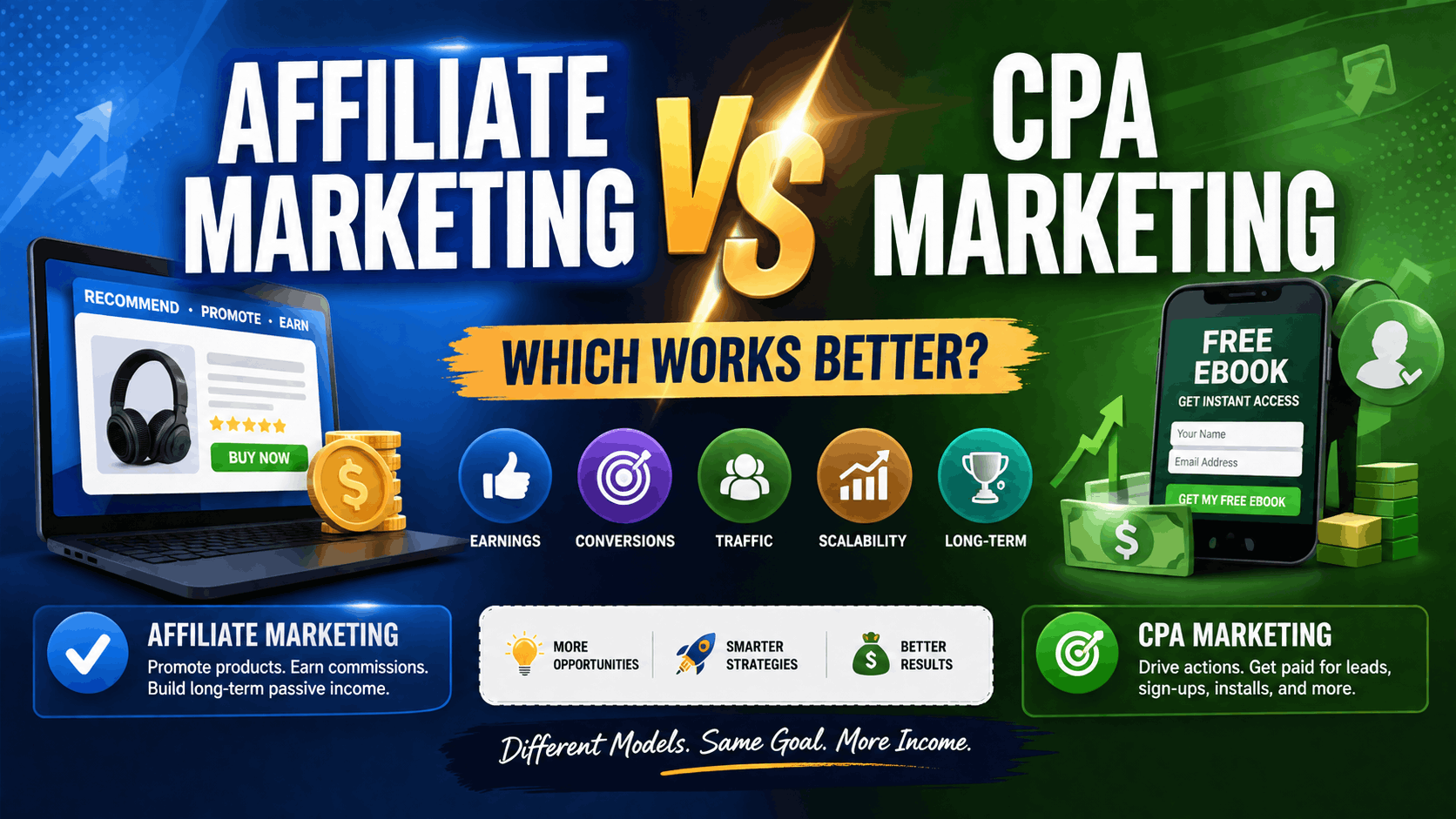
Affiliate marketing and CPA marketing are two of the most popular ways to make money online, but they’re often confused because both involve promoting products or offers for a commission. While they share similarities, they operate on different payment models, marketing strategies, and long-term income potential.
If you’re wondering “Affiliate Marketing vs. CPA Marketing: Which works better?”, the answer depends on your goals, experience, traffic sources, and how you plan to grow your online business. For some marketers, affiliate marketing offers sustainable passive income by earning commissions on product sales. For others, CPA (Cost Per Action) marketing provides quicker payouts by rewarding specific actions such as sign-ups, app installs, or lead submissions—even when no purchase is made.
The challenge for beginners is choosing the right path. Many jump into one model without understanding its strengths, limitations, or earning potential, which often leads to wasted time, rejected offers, or disappointing results. Making an informed decision early can save months of trial and error.
In this comprehensive guide, you’ll learn how affiliate marketing and CPA marketing work, their key differences, earning potential, advantages and disadvantages, ideal traffic sources, common beginner mistakes, and the situations where each model performs best. You’ll also discover whether combining both strategies can maximize your income and help you build a more stable online business.
By the end of this article, you’ll have a clear understanding of which model aligns with your skills, budget, and long-term goals—allowing you to choose the strategy that gives you the best chance of success in today’s competitive digital landscape.
Choose which marketing model fits your goals and start earning smarter. WATCH THIS VIDEO >>>
📚 Table of Contents
- 🚀 Introduction
- 💰 What Is Affiliate Marketing?
- 🎯 What Is CPA Marketing?
- ⚖️ Affiliate Marketing vs. CPA Marketing: The Ultimate Comparison
- 🏆 Which Works Better for You?
- 📈 Proven Strategies to Succeed with Affiliate or CPA Marketing
- ❓ Frequently Asked Questions
- ✅ Final Verdict
What Is Affiliate Marketing?
Affiliate marketing is a performance-based marketing model where you earn a commission by promoting another company’s products or services. Instead of creating your own product, handling inventory, or providing customer support, your role is to connect potential customers with businesses through unique affiliate links. When someone completes a qualifying action—typically a purchase—using your referral link, you receive a commission.
This business model has become one of the most accessible ways to build an online income because it requires relatively low startup costs and can be scaled through blogs, websites, YouTube channels, social media platforms, email marketing, and AI-powered content. Whether you’re a beginner looking for your first online income or an experienced marketer seeking recurring commissions, affiliate marketing offers flexible opportunities across nearly every niche.
Unlike many online business models that require significant investment or technical expertise, affiliate marketing allows you to focus on creating valuable content and helping people make informed buying decisions. The more trust you build with your audience, the greater your potential to generate consistent commissions over time.
How Affiliate Marketing Works
Affiliate marketing follows a straightforward process that benefits both businesses and marketers. Companies reward affiliates for driving qualified customers, while affiliates earn commissions for successful referrals.
The process typically works like this:
- Join an affiliate program or affiliate network.
- Receive a unique affiliate tracking link.
- Promote products or services through valuable content.
- Visitors click your affiliate link.
- Customers complete a qualifying purchase.
- The sale is tracked through cookies or tracking software.
- You earn a commission after the transaction is verified.
The success of affiliate marketing depends less on the number of clicks you generate and more on attracting the right audience with genuine purchase intent.
Types of Affiliate Programs
Not all affiliate programs are the same. Choosing the right type depends on your niche, audience, and long-term income goals.
Physical Products
These programs promote tangible products such as electronics, home appliances, fashion, books, and fitness equipment. Commissions are generally lower, but established brands often have high conversion rates.
Digital Products
Digital products include online courses, software, templates, eBooks, memberships, and marketing tools. They usually offer significantly higher commissions because there are no manufacturing or shipping costs.
SaaS (Software as a Service)
SaaS affiliate programs promote subscription-based software such as email marketing platforms, SEO tools, AI applications, website builders, and CRM systems. Many SaaS companies offer recurring monthly commissions, making them attractive for long-term passive income.
Service-Based Programs
Some businesses pay affiliates for referring customers to services such as web hosting, financial services, legal platforms, or online education. These programs often provide competitive payouts because of their high customer lifetime value.
How Affiliate Marketers Get Paid
Affiliate programs use different commission structures depending on the business model.
- Percentage-Based Commission: Earn a percentage of every successful sale.
- Fixed Commission: Receive a predetermined amount for each qualified purchase.
- Recurring Commission: Continue earning monthly or annually for active subscriptions.
- High-Ticket Commission: Promote premium products that generate larger payouts from fewer sales.
Understanding the commission model helps you estimate your earning potential and choose programs that align with your business strategy.
Advantages of Affiliate Marketing
Affiliate marketing remains one of the most popular online business models because it offers several long-term benefits.
- Low startup costs compared to traditional businesses.
- No need to create or manage your own products.
- Opportunity to earn recurring passive income.
- Flexible work schedule from anywhere.
- Ability to scale through multiple traffic sources.
- Thousands of products available across virtually every niche.
- Ideal for building a trusted personal brand and long-term business.
Disadvantages of Affiliate Marketing
Despite its advantages, affiliate marketing also comes with challenges that every beginner should understand.
- Building trust and organic traffic takes time.
- Income is not guaranteed and depends on consistent effort.
- Competition can be high in profitable niches.
- Commission rates and program terms may change.
- Sales rely on merchant websites and conversion quality.
- Earnings may fluctuate with market trends and algorithm updates.
Approaching affiliate marketing with realistic expectations and a long-term mindset significantly increases your chances of sustainable success.
Who Should Choose Affiliate Marketing?
Affiliate marketing is an excellent choice for individuals who are willing to create helpful content, build audience trust, and focus on long-term growth rather than quick profits.
It is especially suitable for:
- Beginners entering the online business world.
- Bloggers and niche website owners.
- YouTube content creators.
- Social media influencers.
- Email marketers.
- SEO professionals.
- Anyone looking to build a scalable source of passive income.
If your goal is to establish a sustainable online business with multiple income streams and recurring commissions, affiliate marketing is generally the stronger long-term option. It rewards consistency, quality content, and audience trust—three factors that continue to drive success regardless of changes in digital marketing trends.
What Is CPA Marketing?
CPA (Cost Per Action) marketing is a performance-based marketing model where advertisers pay marketers when a user completes a specific action instead of making a purchase. These actions can include submitting a form, signing up for a free trial, downloading an app, installing software, or creating an account.
Unlike traditional affiliate marketing, where commissions are typically earned after a successful sale, CPA marketing focuses on generating qualified leads or user actions. This lower commitment often makes CPA offers easier to convert, especially when promoting free or low-friction offers.
CPA marketing is widely used by businesses that want to increase leads, app downloads, newsletter subscribers, or customer registrations. For marketers, it provides an opportunity to earn commissions without relying solely on product sales. However, success requires targeted traffic, compliance with advertiser guidelines, and continuous campaign optimization.
How CPA Marketing Works
CPA marketing involves four key participants: the advertiser, the CPA network, the marketer (affiliate), and the customer.
The process typically works like this:
- Join a reputable CPA network.
- Apply for and receive approval to promote CPA offers.
- Get a unique tracking link for each offer.
- Promote the offer using your preferred traffic source.
- Visitors complete the required action.
- The CPA network verifies the action.
- You receive a fixed commission for every approved conversion.
Since users usually don’t need to make a purchase, CPA campaigns often generate higher conversion rates than traditional sales-focused campaigns.
Common Types of CPA Offers
CPA marketing includes a wide variety of offers designed to generate different customer actions.
Email or Newsletter Sign-Up
Users submit their email address to receive newsletters, updates, or promotional content. These offers are among the most beginner-friendly.
Free Trial Registration
Visitors sign up for a free trial of a software or online service. Some advertisers may require valid payment information before approving the lead.
App Install
Users download and install a mobile application. These offers are common in gaming, finance, productivity, and entertainment niches.
Form Submission
The user completes an online form to request information, receive a quote, or access a service. This model is widely used in finance, insurance, education, and real estate.
Account Registration
Users create a free account on a website or platform. Payment is made once the registration meets the advertiser’s quality requirements.
Cost Per Call
You earn a commission when qualified users call a business through a tracked phone number and meet the advertiser’s call duration or quality criteria.
How CPA Marketers Get Paid
Unlike affiliate marketing, where commissions are often based on product sales, CPA marketing pays a fixed amount for each verified action.
Common payment models include:
- Cost Per Lead (CPL): Earn when a visitor submits their contact information.
- Cost Per Install (CPI): Get paid for every verified app installation.
- Cost Per Registration (CPR): Earn when users create an account.
- Cost Per Call: Receive commissions for qualified phone calls.
- Cost Per Action (CPA): Get paid whenever a user completes the advertiser’s required action.
The commission amount depends on factors such as the offer type, niche, geographic location, and traffic quality.
Advantages of CPA Marketing
CPA marketing offers several benefits, especially for marketers who focus on lead generation.
- Earn commissions without requiring a product sale.
- Many offers have higher conversion rates because actions are free.
- Suitable for both free and paid traffic strategies.
- Fixed payouts make earnings predictable.
- Wide range of offers across multiple industries.
- Faster campaign testing and optimization.
- Opportunity to scale successful campaigns efficiently.
Disadvantages of CPA Marketing
While CPA marketing can be profitable, it also comes with challenges that marketers should understand.
- Many CPA networks have strict approval requirements.
- Low-quality or fraudulent traffic can result in rejected conversions.
- Advertisers frequently update or remove offers.
- Some campaigns require paid advertising to scale effectively.
- Compliance violations may lead to account suspension.
- Most offers provide one-time commissions rather than recurring income.
Understanding network policies and promoting offers ethically are essential for long-term success.
Who Should Choose CPA Marketing?
CPA marketing is best suited for individuals who enjoy lead generation, testing campaigns, and optimizing conversion rates rather than building long-term product-focused content.
It is particularly suitable for:
- Paid advertising specialists.
- Social media marketers.
- Lead generation experts.
- Email marketers.
- Mobile app promoters.
- Performance marketers.
- Experienced affiliates looking to diversify their income.
Choose which marketing model fits your goals and start earning smarter. WATCH THIS VIDEO >>>
If your strength lies in generating high-quality traffic and optimizing campaigns for conversions, CPA marketing can provide faster payouts and scalable earning opportunities. However, if your goal is to build a long-term online brand with recurring passive income, combining CPA marketing with affiliate marketing is often a more sustainable strategy.
Affiliate Marketing vs. CPA Marketing: The Ultimate Comparison
Both affiliate marketing and CPA marketing allow you to earn money by promoting offers online, but they are designed for different business goals. Affiliate marketing focuses on product sales and long-term income, while CPA marketing focuses on lead generation and faster conversions.
The key question is not which model is universally better, but which one matches your skills, traffic source, and income strategy.
Quick Comparison Table
| Factor | Affiliate Marketing | CPA Marketing |
| Primary goal | Generate product sales | Generate user actions/leads |
| Payment trigger | Customer buys a product | User completes an action |
| Typical payout | 5%–70% commission | $1–$100+ per action |
| Conversion difficulty | Medium to high | Low to medium |
| Passive income potential | Excellent | Limited |
| Best traffic source | SEO, YouTube, Pinterest | Paid ads, social, email |
| Brand building | Strong | Weak |
| Long-term business value | High | Moderate |
| Beginner friendliness | High | Medium |
Business Model: Sales vs. Actions
Affiliate Marketing
You earn when a customer purchases a product through your affiliate link.
Example: A visitor reads your review of an AI writing tool and buys the $49/month subscription. You earn a commission from that sale.
CPA Marketing
You earn when a user completes a specific action, even if they never buy anything.
Example: A visitor signs up for a free finance app trial. You receive a fixed payout for the completed registration.
What this means: CPA marketing usually converts faster because the user commitment is lower, while affiliate marketing often generates higher-value customers.
Payment Structure Comparison
Affiliate Marketing Payments
Common commission models:
- Percentage of sale
- Fixed amount per sale
- Recurring monthly commissions
- Lifetime customer commissions
Example: Web hosting affiliate pays $100 per sale.
CPA Marketing Payments
Common payout models:
- Cost Per Lead (CPL)
- Cost Per Install (CPI)
- Cost Per Registration (CPR)
- Cost Per Call
Example: Insurance quote form pays $12 per approved lead.
Real Earnings Example
| Scenario | Affiliate | CPA |
| 100 visitors | 100 visitors | 100 visitors |
| Conversion rate | 2% buy | 15% sign up |
| Conversions | 2 sales | 15 leads |
| Payout | $60 per sale | $4 per lead |
| Total earnings | $120 | $60 |
This illustrates a common pattern: affiliate marketing may produce fewer conversions but higher earnings per conversion.
Traffic Requirements
Affiliate Marketing Works Best With:
- Google SEO
- Blog articles
- YouTube tutorials
- Pinterest content
- Comparison and review content
These channels attract users who are already researching products.
CPA Marketing Works Best With:
- Facebook Ads
- Native advertising
- TikTok ads
- Push notifications
- Email lead generation
- High-volume social traffic
CPA campaigns often rely on scale and optimization rather than deep content.
Conversion Rates: Which Converts Easier?
CPA Marketing Usually Wins
Free offers remove the biggest barrier: payment.
Example: “Download this free budgeting app” typically converts better than “Buy this $97 budgeting course.”
Affiliate Marketing Wins on Customer Value
A customer who purchases a product is often worth much more than a free lead.
Example: One SaaS customer paying $99/month can generate recurring commissions for years.
Startup Cost Comparison
| Expense | Affiliate | CPA |
| Website | Recommended | Optional |
| SEO tools | Useful | Less important |
| Paid ads budget | Optional | Often needed |
| Landing pages | Sometimes | Frequently |
| Tracking software | Basic | Advanced |
Beginner Reality
- Affiliate marketing: Can start with almost no money using SEO and content.
- CPA marketing: Can start free, but most scalable campaigns use paid traffic.
Risk Level Comparison
Affiliate Marketing Risks
- Google algorithm updates
- Program commission changes
- Merchant conversion issues
- Traffic fluctuations
CPA Marketing Risks
- Ad account bans
- Offer pauses
- Lead rejection
- Compliance violations
- Rapid campaign burnout
CPA marketing generally carries higher operational risk, especially when using paid advertising.
Passive Income Potential
Affiliate Marketing: Excellent
A well-ranked article can generate commissions for months or years.
Example: A “Best AI Tools for Bloggers” article continues earning recurring SaaS commissions while you sleep.
CPA Marketing: Limited
Most CPA earnings stop when traffic stops.
Example: Pause your Facebook ads, and conversions usually stop immediately.
This is why many marketers view affiliate marketing as a digital asset business rather than just a campaign.
Scalability: Which Can Grow Faster?
CPA Marketing Scales Faster
You can increase ad spend and potentially increase conversions within hours.
Affiliate Marketing Scales More Sustainably
Growth is slower initially, but the content compounds over time through SEO, backlinks, and audience trust.
Think of it this way:
- CPA = Fast acceleration
- Affiliate = Long-term compounding
Long-Term Business Value
Affiliate Marketing Builds Assets
You own:
- Your website
- Your email list
- Your content library
- Your brand authority
- Your audience relationship
These assets can often be sold as a business.
CPA Marketing Builds Campaign Expertise
You gain valuable skills in:
- Paid advertising
- Funnel optimization
- Conversion tracking
- Split testing
- Media buying
However, individual CPA campaigns are usually less valuable as standalone business assets.
Side-by-Side Example: Same Niche, Different Models
Niche: Personal Finance
Affiliate ModelLong-term
Affiliate Strategy
Write an SEO article: “Best Budgeting Apps for Beginners”.
- Traffic source: Google SEO
- Offer: Premium budgeting software
- Commission: $40 per sale
- 100 targeted visitors → 3 sales
Estimated earnings
$120
Potential for recurring monthly commissions and long-term passive traffic.
CPA ModelFast conversions
CPA Strategy
Run a social campaign promoting a free budgeting app.
- Traffic source: Facebook or TikTok Ads
- Offer: Free app install
- Payout: $2 per install
- 100 visitors → 25 installs
Estimated earnings
$50
Higher conversion rate, but earnings usually stop when the campaign stops.
The Ultimate Verdict
After comparing business model, payouts, traffic, risk, scalability, and passive income, the strongest conclusion is:
Best overall for beginners & long-term income
Affiliate Marketing
- Builds a real brand and audience.
- Offers recurring passive income potential.
- Works exceptionally well with SEO, blogging, YouTube, and Pinterest.
- Creates assets that can grow in value over time.
Best for fast testing & paid traffic experts
CPA Marketing
- Converts faster because offers are often free.
- Excellent for lead generation and media buying.
- Can scale quickly with profitable ad campaigns.
- Requires stronger tracking, optimization, and compliance skills.
If you’re starting today
A practical 2026 strategy is:
- Start with affiliate marketing to build traffic, authority, and an email list.
- Add selected CPA offers later to monetize leads that are not ready to buy immediately.
That hybrid approach gives you the stability of affiliate marketing and the conversion power of CPA marketing, which is often the most profitable combination for modern digital marketers.
Which Works Better for Different Types of Marketers?
Choosing between affiliate marketing and CPA marketing isn’t about finding a universally better model—it’s about selecting the one that aligns with your skills, experience, traffic sources, and long-term goals. While affiliate marketing excels at building sustainable income and brand authority, CPA marketing is often better suited for marketers who specialize in lead generation and performance-based campaigns.
Here’s which model works best for different types of marketers.
Beginners
If you’re new to online marketing, affiliate marketing is generally the better starting point.
It allows you to learn essential skills such as content creation, SEO, audience building, and email marketing while growing a long-term online business. Although results may take time, the learning experience and business assets you build are valuable.
CPA marketing, on the other hand, often requires understanding tracking, campaign optimization, and advertiser compliance, making it slightly more challenging for beginners.
Best Choice: ✅ Affiliate Marketing
Bloggers
Bloggers naturally attract readers searching for solutions, product recommendations, and buying advice. This makes affiliate marketing an excellent fit.
By publishing reviews, tutorials, and comparison articles, bloggers can earn commissions from highly targeted visitors. Well-optimized articles can continue generating traffic and sales for months or even years.
CPA offers can supplement a blog, but they rarely provide the same long-term earning potential as affiliate product recommendations.
Best Choice: ✅ Affiliate Marketing
YouTube Creators
YouTube creators can succeed with both models, but affiliate marketing usually delivers greater long-term value.
Product demonstrations, software tutorials, and review videos encourage viewers to purchase through affiliate links. These videos can continue attracting views and generating commissions long after publication.
CPA offers work well for free app downloads or registrations but generally provide lower lifetime earnings.
Best Choice: ✅ Affiliate Marketing
Social Media Creators
Creators on platforms like Instagram, TikTok, Facebook, and X often have audiences that respond quickly to short-form content.
CPA marketing performs well when promoting free offers, app installs, or newsletter sign-ups because users can complete the required action with minimal commitment. However, creators who regularly review products or educate their audience can also earn substantial affiliate commissions.
Best Choice: ✅ CPA Marketing for quick actions, Affiliate Marketing for product recommendations
Paid Advertising Marketers
If you’re experienced with Google Ads, Facebook Ads, native advertising, or other paid traffic platforms, CPA marketing often provides faster testing and scaling opportunities.
Since CPA offers typically require only a registration or lead submission, campaigns can achieve higher conversion rates than product sales. Successful marketers continuously optimize ads, landing pages, and targeting to maximize return on investment.
Affiliate marketing also works with paid ads but often requires higher customer intent to remain profitable.
Best Choice: ✅ CPA Marketing
Email Marketers
Email marketers already have a direct relationship with their subscribers, making both business models effective.
Affiliate marketing works exceptionally well when recommending trusted products, software, or online courses through educational email sequences. CPA offers are useful for promoting free resources, webinars, or trial registrations that encourage subscriber engagement.
Combining both strategies often produces the highest overall revenue.
Best Choice: ✅ Affiliate Marketing + CPA Marketing
Full-Time Digital Entrepreneurs
Entrepreneurs focused on building a long-term online business should prioritize affiliate marketing while using CPA marketing as an additional income stream.
Affiliate marketing helps build valuable assets such as websites, content libraries, email lists, and brand authority. CPA marketing can then be integrated into lead-generation funnels to monetize visitors who are not yet ready to purchase.
This diversified strategy reduces dependence on a single income source and creates multiple revenue opportunities.
Best Choice: ✅ Hybrid Approach (Affiliate Marketing + CPA Marketing)
How to Decide Between Affiliate Marketing and CPA Marketing
There isn’t a single “best” option—only the one that aligns with your goals, skills, and preferred way of working online.
Affiliate Marketing Is a Better Fit If…
Affiliate marketing is ideal for people who want to create a long-term digital asset instead of chasing quick wins. If you enjoy educating your audience through blog posts, videos, or other helpful content, this model allows you to build trust while generating income.
It’s also a strong choice if you’re interested in SEO, content marketing, or growing a personal brand. As your audience expands, you can benefit from recurring commissions and passive income opportunities that continue to pay long after your content is published.
CPA Marketing Makes More Sense If…
CPA marketing is well-suited for marketers who enjoy performance-driven campaigns and fast experimentation. Rather than convincing people to purchase products, you’ll focus on encouraging specific actions such as sign-ups, app installs, or form submissions.
If you’re comfortable running paid ads, analyzing campaign data, and continuously optimizing conversion rates, CPA marketing offers the potential to scale successful campaigns quickly. It’s an excellent choice for those who enjoy testing strategies and making data-backed decisions.
Choose which marketing model fits your goals and start earning smarter. WATCH THIS VIDEO >>>
Choose Both if you:
- Want multiple income streams.
- Build content while running lead-generation campaigns.
- Have an email list to monetize in different ways.
- Want to maximize your earning potential without relying on a single business model.
Final Recommendation
For most beginners and content creators, affiliate marketing is the stronger long-term choice because it builds sustainable traffic, audience trust, and recurring income opportunities. CPA marketing becomes increasingly valuable as your marketing skills grow, particularly if you plan to use paid advertising or lead-generation strategies.
Instead of viewing them as competing models, treat them as complementary tools. Starting with affiliate marketing and gradually incorporating carefully selected CPA offers can help you create a more resilient and profitable online business.
How to Succeed with Affiliate Marketing or CPA Marketing
Whether you choose affiliate marketing, CPA marketing, or a combination of both, long-term success depends on using the right strategy rather than chasing quick profits. The most successful marketers focus on understanding their audience, promoting valuable offers, and continuously optimizing their campaigns.
The following best practices will help you build a profitable and sustainable online marketing business.
Choose the Right Niche
Your niche determines the type of audience you attract and the offers you can promote. Selecting a niche with consistent demand and monetization opportunities gives you a stronger foundation for long-term growth.
When choosing a niche, look for:
- Evergreen demand
- Multiple affiliate or CPA offers
- Products or services you understand
- Audience problems you can solve
- Long-term earning potential
Popular niches include AI tools, personal finance, health and fitness, software, web hosting, online education, and digital marketing.
Pro Tip: Focus on one niche first instead of promoting unrelated products across multiple industries.
Select High-Quality Offers
Not every offer is worth promoting. Choose products and CPA campaigns that provide genuine value to your audience.
Before promoting an offer, evaluate:
- Merchant reputation
- Product quality
- Commission structure
- Conversion rate
- Customer support
- Refund policy
- Cookie duration (Affiliate Marketing)
- Approval requirements (CPA Marketing)
Promoting trustworthy offers increases conversions while protecting your credibility.
Create Valuable Content
Content is the foundation of successful affiliate marketing and can also improve CPA campaign performance.
Publish content that answers real user questions, such as:
- Beginner guides
- Product reviews
- Tutorials
- Comparison articles
- Case studies
- Problem-solving articles
Instead of simply inserting affiliate links, explain how a product or service solves a specific problem. Helpful content builds trust and encourages visitors to take action.
Drive Targeted Traffic
Traffic quality matters more than traffic quantity.
Some of the most effective traffic sources include:
- Google Search (SEO)
- YouTube
- Email marketing
- AI search platforms
- Paid advertising (Google Ads, Facebook Ads, Native Ads)
Affiliate marketing performs exceptionally well with content-driven traffic, while CPA marketing often benefits from optimized paid advertising campaigns.
Build Trust and Authority
People buy from marketers they trust. Whether you’re recommending an affiliate product or promoting a CPA offer, honesty and transparency are essential.
You can build trust by:
- Publishing accurate information.
- Sharing real experiences whenever possible.
- Clearly disclosing affiliate relationships.
- Recommending products that genuinely help your audience.
- Updating outdated content regularly.
A trusted audience is far more likely to return, engage with your content, and convert into long-term customers.
Track and Optimize Performance
Successful marketers make decisions based on data rather than assumptions.
Monitor key performance metrics such as:
- Click-through rate (CTR)
- Conversion rate
- Earnings per click (EPC)
- Return on investment (ROI)
- Traffic sources
- Bounce rate
- Top-performing content
Regular analysis helps you identify what’s working, eliminate underperforming campaigns, and maximize your overall profitability.
Common Mistakes to Avoid
Many beginners struggle because they repeat the same avoidable mistakes.
Avoid these common pitfalls:
- Promoting too many offers at once.
- Choosing products solely for high commissions.
- Ignoring keyword research and SEO.
- Relying on only one traffic source.
- Expecting overnight success.
- Neglecting analytics and performance tracking.
- Using misleading or spammy marketing tactics.
Consistency and continuous improvement usually outperform shortcuts.
Can You Combine Affiliate Marketing and CPA Marketing?
Yes—and for many marketers, this is the most effective strategy.
Affiliate marketing is ideal for visitors who are ready to purchase, while CPA marketing can monetize users who prefer free offers or are still in the research stage.
For example:
- Offer a free budgeting app (CPA) to visitors who aren’t ready to buy.
- Later recommend a premium budgeting software (Affiliate Marketing) through follow-up content or email campaigns.
This approach allows you to generate revenue at different stages of the customer journey while reducing dependence on a single income source.
Key Takeaways for Long-Term Success
Regardless of which model you choose, the principles of success remain the same:
- Focus on solving real problems.
- Choose reputable products and offers.
- Create high-quality, user-focused content.
- Drive targeted traffic through multiple channels.
- Build trust before promoting.
- Track your results and optimize continuously.
- Stay consistent and think long term.
Marketers who prioritize value over quick commissions are far more likely to build a profitable online business. By combining smart strategy, continuous learning, and ethical promotion, you can succeed with affiliate marketing, CPA marketing, or a hybrid approach that leverages the strengths of both models.
Conclusion
Affiliate marketing and CPA marketing are both powerful online business models, but they serve different purposes. Affiliate marketing is ideal for building a long-term business by earning commissions from product sales, creating valuable content, and developing a trusted brand. CPA marketing, on the other hand, focuses on generating leads and specific user actions, making it a strong choice for marketers who excel at performance marketing and campaign optimization.
For most beginners, affiliate marketing offers a more sustainable path because it helps build lasting assets such as a website, email list, and evergreen content that can generate recurring income over time. CPA marketing can deliver faster results, especially when combined with paid advertising, but it often requires continuous optimization and traffic generation to maintain earnings.
Choose which marketing model fits your goals and start earning smarter. WATCH THIS VIDEO >>>
Rather than choosing one over the other, many successful marketers combine both strategies. They use affiliate marketing to monetize high-intent buyers while leveraging CPA offers to capture leads from users who aren’t ready to make a purchase. This diversified approach can increase conversions, reduce reliance on a single income source, and create a more resilient online business.
Ultimately, success doesn’t depend on whether you choose affiliate marketing or CPA marketing—it depends on your ability to understand your audience, promote high-quality offers, create genuinely helpful content, and consistently optimize your marketing efforts. Start with the model that best matches your skills and goals, stay focused on delivering value, and expand your strategy as your experience grows. With patience, consistency, and continuous learning, either model—or a combination of both—can become a reliable source of long-term online income.
Frequently Asked Questions (FAQs)
1. What is the main difference between affiliate marketing and CPA marketing?
The biggest difference is how you earn commissions. Affiliate marketing pays you when a customer purchases a product or service through your referral link, while CPA (Cost Per Action) marketing pays you when a user completes a specific action, such as signing up for a free trial, filling out a form, or installing an app. Affiliate marketing is generally better for long-term passive income, whereas CPA marketing often focuses on lead generation and faster conversions.
2. Which is better for beginners: Affiliate marketing or CPA marketing?
For most beginners, affiliate marketing is the better choice because it teaches valuable skills like content creation, SEO, audience building, and email marketing. It also offers recurring commissions and long-term growth. CPA marketing can be profitable but usually requires a stronger understanding of traffic generation, tracking, and campaign optimization.
3. Can I do affiliate marketing and CPA marketing at the same time?
Yes. Many successful marketers combine both models. You can use CPA offers to monetize visitors who aren’t ready to buy while promoting affiliate products to users with strong purchase intent. This hybrid strategy helps diversify your income and maximize conversions.
4. Which business model has higher earning potential?
Both can be highly profitable, but the earning potential depends on your traffic quality, niche, and marketing strategy. Affiliate marketing often generates higher long-term income through recurring commissions and premium products, while CPA marketing can produce faster short-term earnings by driving large volumes of qualified leads.
5. Does affiliate marketing require a website?
No. Although having a website is highly recommended for long-term SEO and authority, you can also promote affiliate products through YouTube, social media, email newsletters, podcasts, or other content platforms. A website simply gives you greater control over your business and traffic.
6. Can I start CPA marketing without a website?
Yes. Many CPA marketers successfully promote offers using social media, paid advertising, email marketing, or mobile campaigns without owning a website. However, landing pages often improve conversion rates and provide a better user experience.
7. Which traffic source works best for affiliate marketing?
Affiliate marketing performs best with high-intent traffic sources, including:
- Google SEO
- Blogging
- YouTube
- Email marketing
- AI search platforms
These channels attract users who are actively researching products before making a purchase.
8. Which traffic source works best for CPA marketing?
CPA marketing typically performs well with:
- Facebook Ads
- Google Ads
- Native advertising
- TikTok Ads
- Email marketing
- Push notifications
- Social media campaigns
Since CPA offers usually require only a simple action, they often convert well with paid traffic.
9. Is CPA marketing easier than affiliate marketing?
In terms of conversions, CPA marketing is often easier because users don’t usually need to purchase a product. However, managing profitable CPA campaigns requires skills in tracking, optimization, compliance, and traffic management. Affiliate marketing generally has a slower learning curve but builds stronger long-term assets.
10. Which model generates passive income?
Affiliate marketing offers greater passive income potential. A well-ranked blog post, YouTube video, or evergreen guide can continue generating commissions for months or even years. CPA marketing usually requires ongoing traffic generation, so income often stops when campaigns stop.
11. How much money can beginners earn with affiliate or CPA marketing?
There is no guaranteed income. Beginners may earn their first commissions within weeks or several months, depending on the quality of their content, traffic, niche, and consistency. As experience grows, both affiliate and CPA marketing can scale significantly with effective strategies.
12. Can AI help improve affiliate marketing and CPA marketing results?
Yes. AI tools can assist with keyword research, content creation, SEO optimization, ad copy, email campaigns, landing pages, and data analysis. However, combining AI-generated content with original insights, real experience, and helpful information generally produces better results than relying on AI alone.
13. Is affiliate marketing or CPA marketing better for long-term business growth?
Affiliate marketing is generally the stronger choice for building a long-term online business because it helps you create valuable assets such as a website, email list, trusted brand, and evergreen content. CPA marketing is excellent for generating leads and testing campaigns but often depends on continuous traffic acquisition.
14. How do I choose between affiliate marketing and CPA marketing?
Choose affiliate marketing if you want to build a content-based business with recurring income and long-term growth. Choose CPA marketing if you’re interested in lead generation, paid advertising, and performance marketing. If your goal is to maximize earnings, combining both models is often the most effective strategy.
15. Which is the best choice in 2026 and beyond?
For most beginners and content creators, affiliate marketing remains the best long-term choice because it builds authority, passive income, and sustainable business assets. CPA marketing is an excellent complement for monetizing leads and increasing overall revenue. A balanced strategy that leverages both models offers the greatest flexibility and resilience in the evolving digital marketing landscape.
Thanks for reading my article. I am helping beginners build sustainable online income through practical affiliate marketing, SEO, AI tools, and proven digital marketing strategies.
“The best marketing model isn’t the one that pays the most—it’s the one you can grow consistently.”